
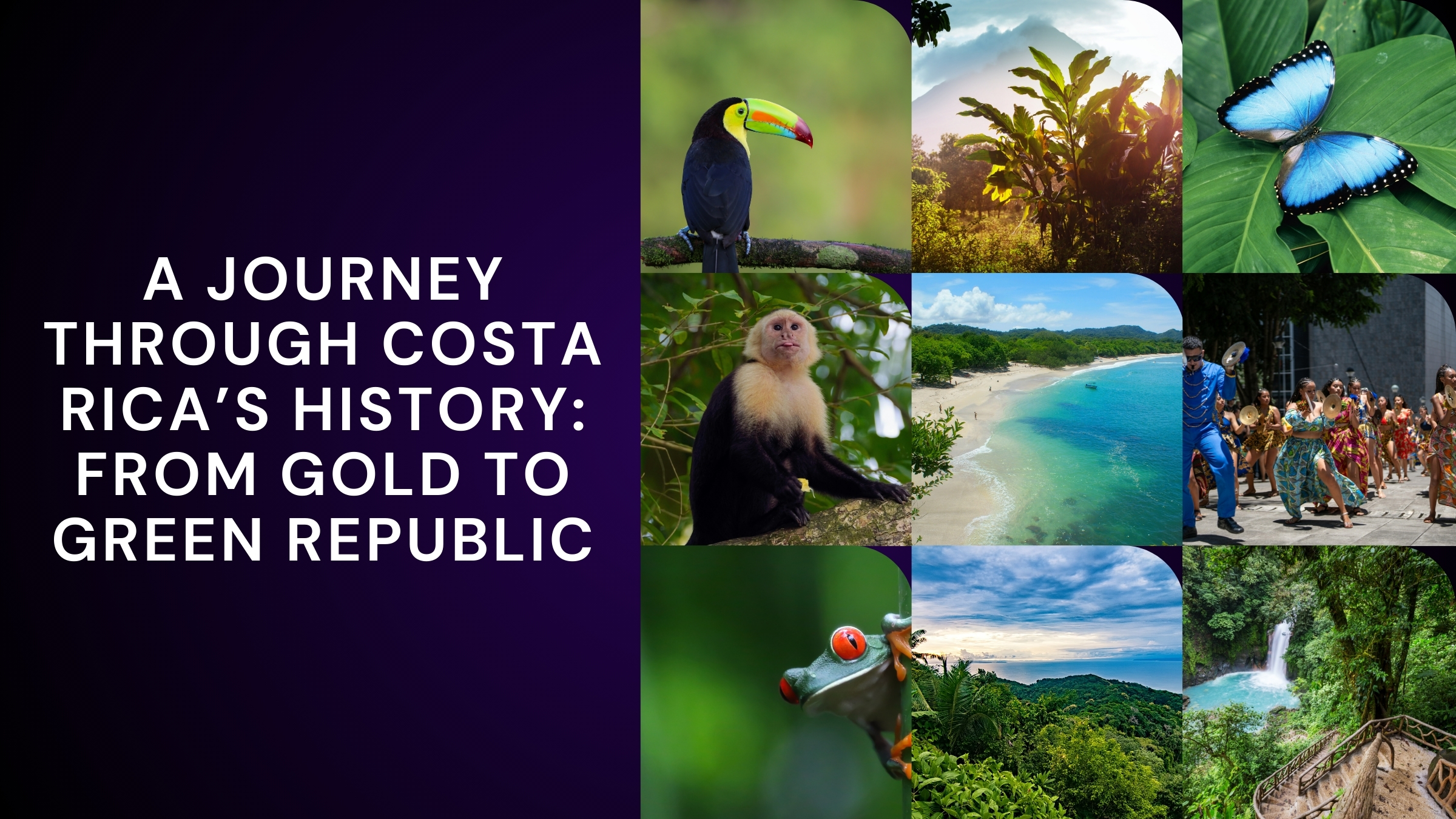
When you think of Costa Rica today, you likely picture rainforests teeming with toucans, coffee farms tucked into emerald hills, and the rarest of modern miracles: a nation without an army. But the story of how Costa Rica became this “green republic” is far richer than postcards and tourist brochures suggest. Let’s trace the path of this small Central American country, uncovering the layers of history that have shaped its unique identity.
Before Columbus: A Land Between Worlds
Long before Europeans arrived, Costa Rica sat at the crossroads of two great civilizations: the Maya of the north and the Inca of the south. Archaeologists find Costa Rican artifacts that blend styles from both cultures, from jade carvings (a Mesoamerican specialty) to gold ornaments crafted with techniques known in Colombia.
One of the most intriguing legacies of this era is Costa Rica’s mystery spheres, perfectly round stone balls, some as large as six feet in diameter. Created by the Diquís culture more than a thousand years ago, they remain a riddle. Were they status symbols? Cosmic markers? Pathway guides? To this day, no one knows for sure.
The Spanish Arrive
Christopher Columbus landed on Costa Rica’s Caribbean coast in 1502, during his fourth and final voyage. His men, dazzled by the local gold jewelry, called the place the “Rich Coast.” Ironically, it turned out to be one of the least profitable colonies in the Spanish Empire.
Unlike Mexico or Peru, Costa Rica had no grand cities, no mines brimming with silver, and no dense population to provide forced labor. Colonists found themselves hacking through swamps, battling tropical diseases, and working the land themselves, a rarity in the empire. This lack of riches earned Costa Rica the reputation of being the neglected, poor, but oddly free territory.
Fun fact: Because few indigenous people survived the conquest (many died from diseases or fled to remote areas), Costa Rica became one of the few Spanish colonies where small farmers, not Encomenderos with vast estates, formed the backbone of society. This laid the groundwork for the country’s later democratic traditions.
Independence Without Blood
When the rest of Central America declared independence from Spain in 1821, Costa Rica barely noticed. No battles were fought; no revolutionaries stormed the streets. News of independence arrived weeks late, carried by a courier from Guatemala.
Even after independence, Costa Ricans bickered over whether to join Mexico, stick with Central America, or go it alone. Eventually, they chose the latter. Compared to its neighbors, many of which endured decades of civil wars, Costa Rica’s birth as a nation was remarkably calm.
Coffee: The “Golden Bean”
In the 19th century, Costa Rica finally found its treasure: coffee. The crop thrived in the volcanic soil of the Central Valley, and by the 1830s, it was being exported to Europe. Coffee created a new elite of wealthy planters, some of whom built the ornate National Theater in San José—a gem of neo-classical architecture that still dazzles visitors today.
But coffee also brought modernization. Profits funded schools, railroads, and eventually a more stable democratic system than most of Latin America’s. A local saying captures this perfectly: “Coffee built the nation.”
A quirky detail: Britain was Costa Rica’s first big buyer of coffee, but because there was no direct shipping route, the beans had to be carried overland by oxcart to the Pacific coast, shipped to South America, then rounded Cape Horn to London. This journey could take months.
The Odd Little War with William Walker
Here’s a story few outside Costa Rica know. In the 1850s, an American adventurer named William Walker tried to turn Central America into his own private slaveholding empire. He seized control of Nicaragua and eyed Costa Rica next.
Costa Ricans rallied against him in the Battle of Rivas (1856), where national hero Juan Santamaría, a poor drummer boy, famously set fire to a building sheltering Walker’s men. Santamaría died in the flames, but his sacrifice turned the tide of the war. Today, he is celebrated as Costa Rica’s national hero, proof that one brave teenager can change a nation’s destiny.
Democracy Interrupted; and Restored
Costa Rica experimented with democracy early on, but like much of Latin America, it wasn’t immune to coups and strongmen. The most dramatic crisis came in 1948, when a disputed presidential election triggered a short but bloody civil war.
Emerging from the conflict was José Figueres Ferrer, a reformist leader who did something extraordinary: he abolished the army. Costa Rica became the first country in the world to constitutionally ban its military, choosing instead to invest in education, healthcare, and environmental protection.
The decision was radical at the time, but it worked. Freed from military spending, Costa Rica built one of the highest literacy rates and life expectancies in Latin America.
The Green Republic
In the late 20th century, Costa Rica embraced another identity: global leader in environmental protection. The country pioneered national parks, reforestation, and eco-tourism, turning its biodiversity into both a treasure and an economic engine. Today, over 25% of its land is protected, a higher percentage than almost anywhere else on Earth.
Costa Rica also became a champion of renewable energy. In some years, more than 98% of its electricity comes from renewable sources, hydropower, wind, and geothermal.
And perhaps most impressive of all: despite sitting in a region plagued by drug wars, dictatorships, and instability, Costa Rica remains a peaceful democracy, earning it the nickname “the Switzerland of Central America.”
Why Costa Rica Captivates
Costa Rica’s history is full of paradoxes: a land called “rich” because of gold that barely existed; a colony too poor to exploit, which became freer than most; a nation that won its biggest war thanks to a teenage drummer; and a country that dismantled its army only to grow stronger.
It is these quirks, these unlikely turns of fate, that have shaped the Costa Rica we know today: not rich in silver or gold, but in peace, green forests, and an enviable quality of life.