
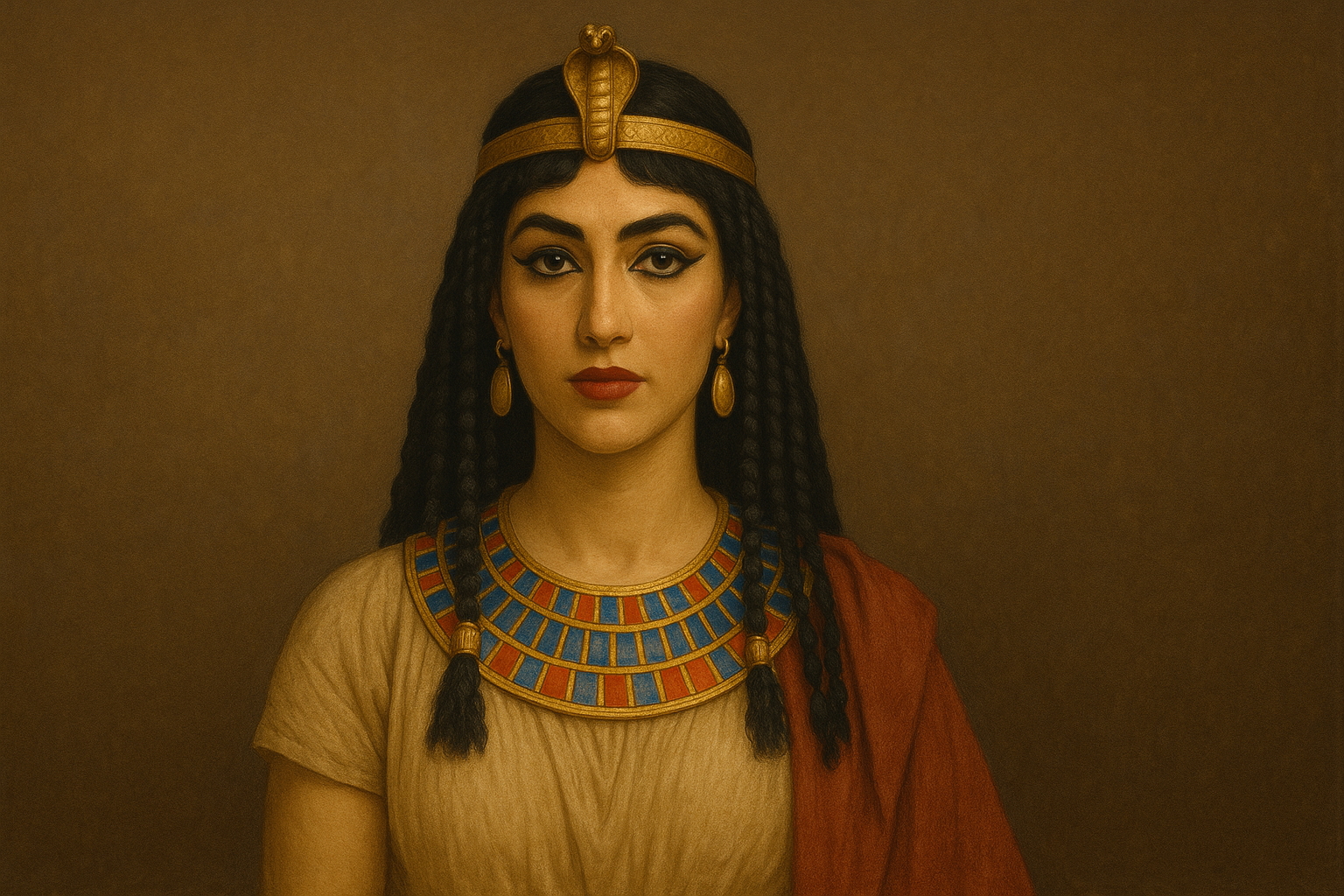
When most people hear the name Cleopatra, they imagine an exotic seductress draped in gold, a queen who toppled mighty empires with the sway of her beauty. Yet the real Cleopatra VII Philopator, the last ruler of Ptolemaic Egypt, was far more than the legend. She was a polyglot, a strategist, and a political survivor in a world dominated by Rome. Her rise and fall was not a story of seduction alone, but of intellect, ambition, and the shifting tides of empire.
A Queen of Many Tongues
Unlike her Ptolemaic predecessors, Cleopatra actually spoke Egyptian, a rare act of cultural integration by her Greek-descended dynasty. Ancient sources suggest she knew as many as nine languages, including Hebrew, Aramaic, and perhaps even Ethiopian. Plutarch later remarked that her voice and conversation were more persuasive than her looks. Her linguistic skill was more than a parlor trick; it was a tool of diplomacy. Cleopatra could speak directly to foreign envoys without the need for interpreters, a decisive advantage when Rome’s influence loomed over Egypt.
How She Rose to Power
Cleopatra came to the throne in 51 BCE at just 18, co-ruling with her ten-year-old brother Ptolemy XIII. Power struggles soon erupted. When the siblings clashed, she was forced into exile, only to return with the most famous gamble of her career: aligning herself with Julius Caesar. Legend says she had herself smuggled into Caesar’s chambers, rolled inside a carpet (though Plutarch claims it was a bed sack). However it happened, the encounter sealed an alliance. With Caesar’s support, she regained her throne, ruling jointly, though Ptolemy XIII drowned soon after in battle, leaving Cleopatra firmly in charge.
Little-Known Aspects of Her Reign
Economic Reformer: Cleopatra lowered taxes during famines, opened Egyptian granaries, and stabilized the kingdom’s currency.
Religious Role: She presented herself as the living embodiment of the goddess Isis, a move that granted her divine authority in the eyes of her subjects.
Scholar at Heart: Raised in Alexandria, home to the legendary Library, she was deeply educated in philosophy, astronomy, and medicine, unusual for rulers of her age.
The Fall of the Queen
After Caesar’s assassination in 44 BCE, Cleopatra’s future was precarious. She found her next ally in Mark Antony, one of Rome’s most powerful generals. Their union was both political and personal; they had three children together. However, in Rome, their relationship was portrayed as dangerous. Antony had become “Egyptianized,” abandoning Roman virtues for the luxuries of the East. Their defeat at the Battle of Actium in 31 BCE sealed her fate. Octavian (later Augustus), Caesar’s heir, invaded Egypt. Antony, hearing a false rumor that Cleopatra was dead, fell on his sword.
Cleopatra’s Death: Serpent or Strategy?
On August 12, 30 BCE, Cleopatra ended her life. The popular story is that she let an asp (Egyptian cobra) bite her, dying a queen’s death as Isis incarnate. Ancient sources differ, though: Plutarch hedges that it might have been poison applied with a hairpin. What is clear is that she chose death rather than humiliation in a Roman triumph. With her passing, the Ptolemaic dynasty, descended from Alexander the Great’s generals, came to an end. Egypt was absorbed into the Roman Empire.
Legacy Beyond the Myth
Cleopatra’s image has been distorted for centuries, turned into a femme fatale in Roman propaganda and Hollywood films. Yet the real woman was far more formidable. She was the last pharaoh of Egypt, a ruler who wielded intellect, language, and statecraft as fiercely as any general wields a sword.
As the historian Stacy Schiff put it, Cleopatra’s story is a reminder of “how much of history is written from the point of view of those who destroy”. She was not simply a lover of Caesar and Antony, but a monarch fighting to preserve her nation’s sovereignty in the face of Rome’s unstoppable rise.
Sources:
- Plutarch, Life of Antony
- Cassius Dio, Roman History 42.34
- Tyldesley, Joyce. Cleopatra: Last Queen of Egypt (Profile Books, 2008) Ashton, Sally-Ann. Cleopatra and Egypt (Blackwell, 2008)
- Roller, Duane W. Cleopatra: A Biography (Oxford University Press, 2010) Plutarch, Life of Antony 86
- Schiff, Stacy. Cleopatra: A Life (Little, Brown and Company, 2010)