
Pompeii was not a “ruin” when Vesuvius woke. It was a working town with sore feet and full wine cups, with arguments over property lines and dinners that ran late. It smelled of bread and olive oil, of dye vats and damp stone. On its streets, you could read the rhythms of Roman life: painted shop signs, electoral slogans scrawled on walls, shrines tucked into corners, the neat arrogance of colonnades and the practical chaos of traffic ruts. Mary Beard has long insisted we resist the postcard version of Pompeii, the tidy museum of “everyday life.” It was a place where people lived amid noise, repairs, status anxiety, and the constant bargaining between what one wanted to be and what one could afford.
And the repairs mattered. Because the ground had been reminding Pompeii, for years, that it lived in the shadow of a volcano.
A severe earthquake struck the region in 62 or 63 CE, damaging buildings across the Bay of Naples. Pompeii spent the next decade and a half in a kind of civic convalescence, scaffolding and reconstruction threaded through daily life. Some houses were restored lavishly; others limped along with patched walls and improvised fixes. In at least one home in Regio V, an atrium was undergoing renovation close to the final disaster. On a wall, someone wrote in charcoal a date equivalent to October 17. Charcoal is perishable. It is not the sort of thing you expect to survive for months, let alone years, on a busy wall. The implication is quiet but enormous: Pompeii was still alive in mid-October.
That scribble is one of the reasons many scholars now treat an autumn eruption as more likely than the traditional late-August date found in some later manuscript traditions of Pliny’s letters. The argument is not built on one clue alone. It’s a case assembled the way good historical cases are assembled: mundane details that, taken together, refuse to fit the old story.
Still, Pompeii did not feel like a town awaiting apocalypse. It felt like a town.
Then, sometime after midday, the mountain made itself the only subject worth discussing.
The “Pine Tree” in the Sky
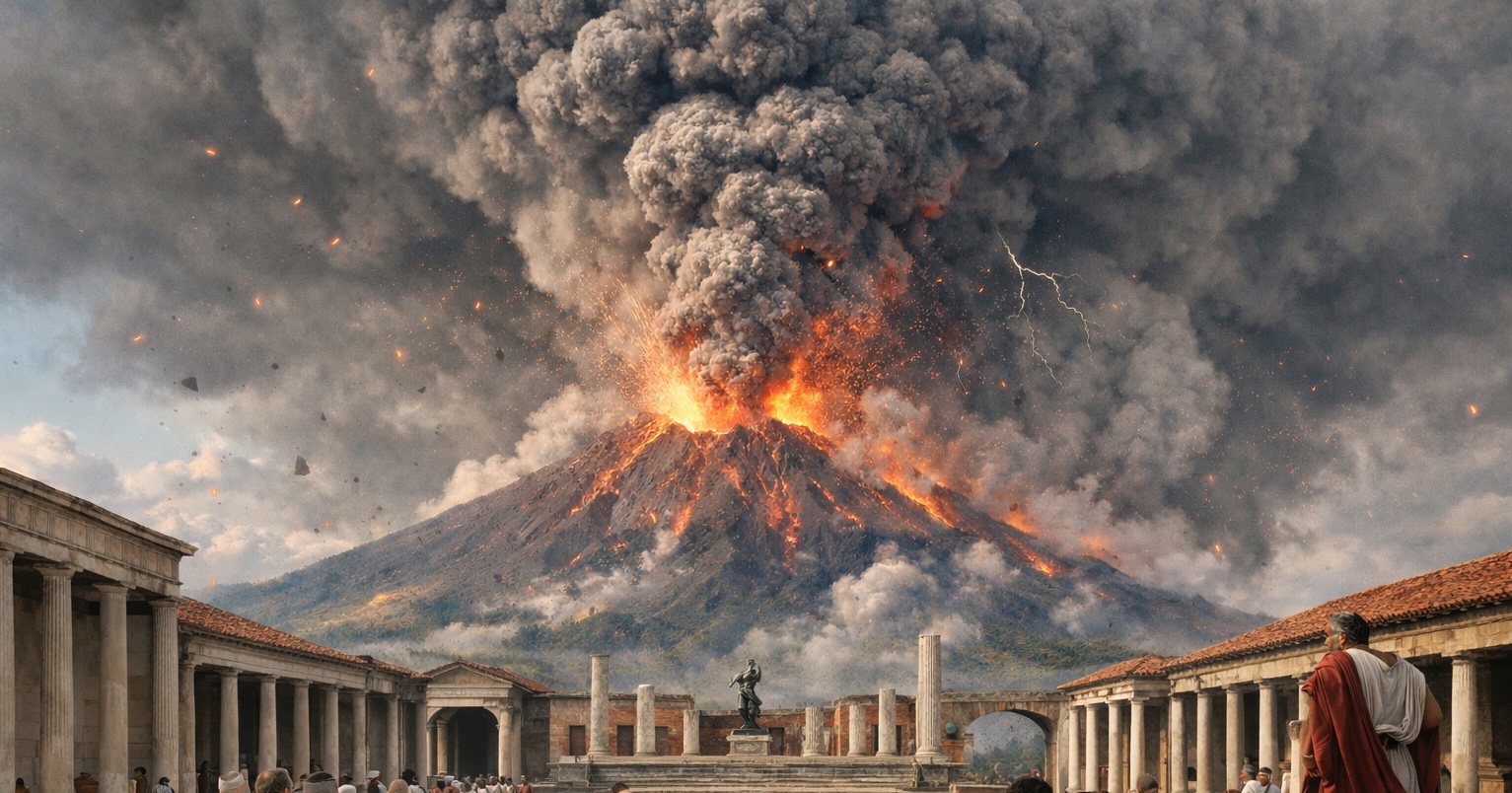
Our most vivid ancient witness is Pliny the Younger, writing years later to the historian Tacitus. He was across the Bay at Misenum, far enough to observe, close enough to feel the fear. He described a cloud rising in the shape of a pine tree: a tall “trunk” pushing upward, then spreading into branching mass. It is one of those lines that makes you feel history tighten around the throat, because the image is not literary ornament. It matches what volcanologists recognize as a towering eruption column, built by hot gases and pulverized rock thrust violently into the atmosphere.
Pliny’s letters do more than supply drama. They give sequence: the suddenness of the first blast, the confusion, the shifting decisions of people trying to choose between walls that might collapse and roads that might vanish. In the first letter, his uncle, Pliny the Elder, organizes boats, intending at once to study the phenomenon and to help people trapped along the shore. That blend of curiosity and duty, so Roman in its self-conception, ends in death.
The volcano’s first phase pummeled Pompeii with pumice and ash. For hours, the town endured an unnatural weather: stones light enough to fall in drifts, ash that thickened into choking dusk. Roofs began to fail under accumulating weight. Streets became difficult, then impassable. People wrapped their heads, as Pliny says some did, to protect against falling debris. In the midst of it all, there were choices, each one made with partial knowledge and a narrowing horizon.
In Pompeii itself, the archaeological record captures those decisions with cruel clarity: bodies found in doorways, in courtyards, under stairwells, in rooms that look, even now, like they were meant to be temporary refuge. Some fled early and lived. Others waited, perhaps hoping the fall would ease, perhaps unwilling to abandon homes, children, elderly parents, or valuables that could not be carried.
The tragedy is that the worst was still ahead.
When the Eruption Changed Its Mind
Volcanologists reconstruct the 79 CE event as a complex, evolving eruption with distinct phases. The prolonged fall deposit did terrible damage, but it also created a brutal illusion: the town was suffering, yet it was still there. People could still breathe, still move, still decide.
Then, as the eruption column became unstable, gravity won. The column collapsed, and pyroclastic density currents surged outward: ground-hugging avalanches of hot gas, ash, and rock fragments moving with lethal speed and heat. These currents are the signature killers of many explosive eruptions, and modern stratigraphic studies around Vesuvius keep refining their timing, paths, and intensity.
Herculaneum, closer to the volcano but initially spared the heavy pumice fall by wind direction, faced a different horror: sudden pyroclastic surges that overwhelmed the town. Scientific work continues to investigate exactly how heat and ash interacted with buildings and bodies, and how quickly death occurred. Some interpretations argue for extremely rapid fatal thermal shock in certain contexts, while others emphasize a range of lethal mechanisms across different locations and moments of the event. The point, for anyone trying to imagine it honestly, is not a single cinematic “death scene.” It is an environment turning uninhabitable in minutes.
Pompeii, farther downwind, was struck after hours of fall. The town that had been battered and dimmed was then, in effect, erased.
And the ash did something else: it preserved.
The Preservation That Feels Like a Betrayal
When bodies decomposed beneath hardened ash, they left voids in the compacted deposit. In the 19th century, the archaeologist Giuseppe Fiorelli developed a method of pouring plaster into those cavities, producing casts that captured final postures with unsettling intimacy. Pompeii’s own archaeological park notes that this casting method, perfected by Fiorelli, dates to 1863.
It is hard to overstate what that meant for the modern imagination. Earlier excavations, beginning under the Bourbon rulers in the 18th century, had already drawn Europe’s attention, but Fiorelli’s casts gave Pompeii a human face. They also gave it a moral weight. You are not looking at “the past.” You are looking at a person who had a name, even if we no longer know it.
Modern science has kept returning to those casts, not just as icons, but as data. Recent work has even extracted genomic information from skeletal material associated with casts, complicating some older assumptions about identities and relationships and reminding us, again, that Pompeii’s population was not a simple, homogenous “Roman town,” but part of a mobile Mediterranean world.
So the city endures in two registers at once: as an extraordinary archive of buildings, art, and objects; and as a cemetery that refuses to stay abstract.
The Problem of Dates, and Why It Matters
For centuries, popular retellings pinned the eruption to August 24, 79 CE, a date that entered print through manuscript traditions of Pliny’s letters. But the case for an October eruption has become increasingly persuasive to many scholars, especially after the discovery of the charcoal inscription referencing a mid-October date in a house under renovation. A leading scientific news outlet summarized the implication bluntly: a note likely written in October makes an August catastrophe harder to defend.
This is not pedantry. The date shapes how we picture Pompeii’s final days: what foods were in season, what clothing people might have worn, what agricultural work was underway, why certain goods appear in shops and storerooms. It shapes the town’s weather, the length of daylight, the feel of the air. History is often rebuilt from such “small” hinges.
The honest scholarly posture is this: we can be confident about the eruption’s sequence and effects, and increasingly confident that late summer is not the only plausible window, while still acknowledging that ancient textual transmission and fragmentary evidence can resist absolute certainty. What has changed is not that we have solved every detail, but that Pompeii keeps producing evidence that forces the story to stay alive.
Afterlife: The Town That Refused to Stay Buried
Pompeii’s second life began not with a neat scientific project, but with treasure-hunting impulses and courtly prestige. In the Bourbon era, excavations in the region sought statues, frescoes, and marvels for royal collections, and the work at Pompeii gathered momentum in the mid-18th century as digging shifted to areas where volcanic deposits were easier to remove.
Over time, methods changed. Documentation improved. The emphasis slowly turned from “find me something beautiful” to “tell me what this place was.” Yet even in modern times, Pompeii’s preservation is a constant struggle against weathering, tourism pressure, and the delicate fragility of exposed walls and paintings. Every generation inherits the same dilemma: excavation reveals, but excavation also endangers.
And that is perhaps Pompeii’s final lesson, woven into the very act of looking at it. We do not receive the past as a gift. We prise it open, and in prising it open we alter it.
Pompeii is not merely a disaster story. It is a record of ordinary life, interrupted. It is the reminder that civilizations do not only fall in grand political collapses or epic wars. Sometimes they fall in a long afternoon, beneath a cloud shaped like a tree.