
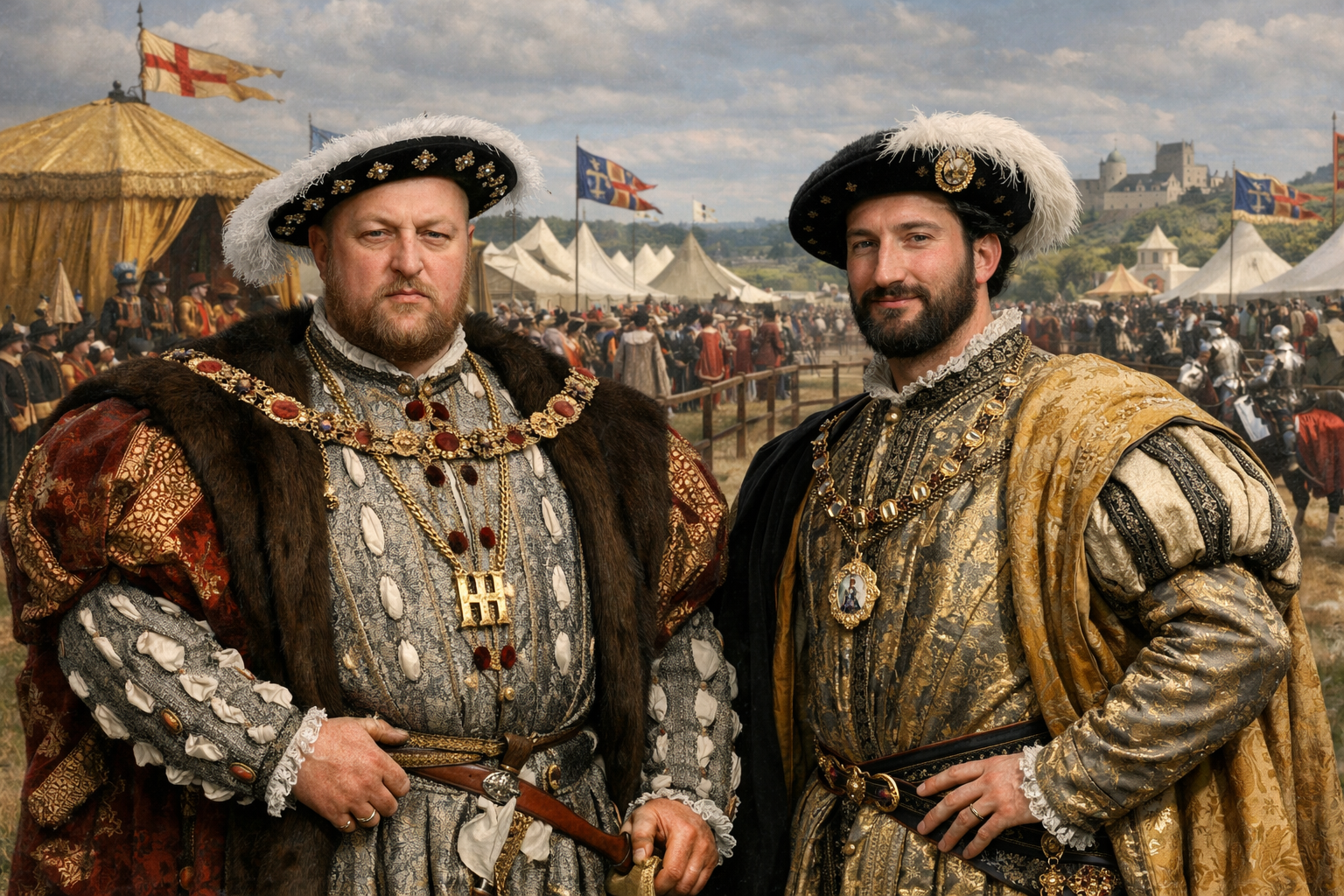
On the evening of 7 June 1520, a shallow valley near Calais became the most expensive argument in Europe.
From one direction came Henry VIII, not yet the looming, injured tyrant of later legend, but a young king (still in his twenties) who wanted Europe to see England as a first-rank power. From the other came Francis I of France, only a few years younger, brilliant, swaggering, and determined that the Renaissance would wear French colors. They met in the Val d’Or (Golden Valley) between Guînes (in the English-held Pale of Calais) and Ardres (French territory), embraced publicly, and stepped into a golden tent as if friendship could be staged into permanence.
What followed was eighteen days of feasting, tournaments, masques, religious services, and competitive magnificence: a purpose-built world where peace was supposed to feel inevitable because it looked so lavish.
Why “Universal Peace” Needed a Tournament
To understand the Field of Cloth of Gold, you have to stop thinking like a modern diplomat and start thinking like a sixteenth-century one. Peace was not merely negotiated. It was performed.
The meeting grew from the late-1510s push for what contemporaries called a “Universal Peace” in Christendom, associated with the great treaty-making moment in London (often linked with the Treaty of London). Humanists and churchmen preached peace as a Christian duty and a princely virtue; kings learned to treat peace as a form of prestige. The point was not simply to stop wars, but to proclaim who had the authority and grandeur to make peace.
And tournaments mattered here. In this political culture, a tournament was not escapism. It was an elite language: controlled violence, choreographed honor, and a public scoreboard for who belonged among the great powers. As Glenn Richardson puts it in his lecture on the event, the Field was “first and foremost” a tournament inaugurating that peace, a “war-game” with rules that had real political implications.
So when Henry and Francis agreed to meet, they were not “throwing a party.” They were constructing a temporary universe where rivalry could be contained inside pageantry.
The Stage: A Temporary City Built to Dazzle
Both kings arrived with entourages that modern readers always underestimate. Richardson describes each royal camp as some 5,000–6,000 strong, housed in a forest of tents and pavilions dressed in luxury textiles, especially the glittering fabric literally woven with gold thread that gave the event its name. Even if you don’t accept any single headline crowd figure, those entourage numbers alone put the combined presence well into the five figures, before you add traders, laborers, clergy, performers, and spectators.
The logistics were staggering, and they mattered politically because they signaled state capacity. The French prepared materials far away and hauled them north; the English built a great temporary banqueting “palace” outside Guînes, painted to look like masonry, and glazed so heavily the French reportedly nicknamed it a kind of “crystal” construction. The point was not comfort. The point was astonishment.
Even the location was part of the script. It sat near English territory, French territory, and not far from Habsburg lands, which meant every display carried a second message: we are rich enough to do this, organized enough to secure it, and strong enough to risk meeting in person.
And risk was real. The ceremony required equality down to the physical landscape. Both sides worried about an ambush. At the final approach, tensions spiked so sharply that a misunderstanding over glittering coats nearly halted the meeting. The peace had guards at its throat.
Masculinity as Policy: Why Everything Had to Be Competitive
This is the part modern readers miss if they treat the Field like Renaissance cosplay.
The early-sixteenth-century monarchy was intensely personal. Kings went to war, but they also were the war. Reputation, bravery, athletic skill, and magnificence were political assets. You could not separate diplomacy from the king’s body, because in a world without mass elections and televised debates, the royal body was the brand.
Henry and Francis both believed they were born for greatness. Both were athletic. Both were cultivated. Both were ambitious, and both needed the other to recognize it publicly. The Field did that through a controlled rivalry: each side tried to outshine the other in tents, clothing, feats, and ceremony, while still maintaining the official fiction of brotherly friendship.
The Wrestling Match: A “Trivial” Moment That Wasn’t Trivial
On a day when bad weather interrupted the planned tournament schedule, the kings filled the time with other sports. According to Historic Royal Palaces’ account, after French wrestlers had challenged the English, Henry abandoned protocol, grabbed Francis, and challenged him directly. Francis, raised in a region famed for wrestling, threw him to the ground.
Another academic discussion of the event describes the scene with blunt clarity: after French victory in team wrestling, Henry challenges Francis; Francis gives him “un tour de Bretagne,” a spectacular throw that leaves Henry “bitter and humiliated.”
If you want the Field in miniature, it’s there: two monarchs trying to translate physical dominance into political meaning, and discovering that a human body has a way of refusing to cooperate with statecraft.
Was the match “the reason” peace failed? No. That would be melodrama.
But it mattered because it revealed what the Field was always trying to manage: the fragile boundary between symbolic competition and real rivalry. The games were meant to avoid direct king-versus-king confrontation. Henry, impulsive (and likely feeling the heat of comparison), broke the script. Francis won. Everyone watching learned something they were not supposed to learn in public.
The Field was designed to make equality look effortless. Wrestling exposed how hard the performance really was.
Queens, Clergy, and the Politics of Spectacle
It’s also worth rescuing the event from the tired “two kings showing off” frame, because that’s not how it functioned on the ground.
Queens mattered. Catherine of Aragon and Queen Claude were not decorative props; they participated in hosting, banquets, and ceremonial exchanges. Their presence reinforced dynastic legitimacy and the idea that this peace bound households and futures, not just two young men with egos.
Religion mattered. The Field folded worship into the festivities because European diplomacy still described itself as a Christian project. “Universal Peace” was imagined as peace in Christendom, not a secular “balance of power” system. That’s one reason the ceremonies included religious services alongside tournaments and feasts.
And labor mattered, too, even if elite art and later romantic retellings try to keep working people out of frame. One scholarly reflection on the Field notes how accounts (via Hall) describe the presence of laborers, wagoners, beggars, and drunken crowds, whose disorder threatened to break the spell of co-magnificence. The point is simple: the Field tried to manufacture a perfect political image, but reality kept wandering into the shot.
Why It Didn’t “Work”: The Calendar of Reality
Here’s the cold truth that pageantry cannot bribe:
The Field was never operating in a world where England and France were the only players.
A third giant hovered over the whole scene: the Habsburg orbit, embodied most dangerously by Charles V (and the wider imperial power network around him). Even in the HRP narrative, French anxiety spikes over Henry’s contacts with Charles, because alliances were shifting and no one wanted to be the last to notice.
And shift they did.
By August 1522, English state papers describe Henry having “taken part against France” within a broader league, with intense naval planning and an “enterprise by land” being discussed at the top levels. In other words: within roughly two years of the Field’s embrace, the machinery of war was back in motion.
So what failed?
Not the craftsmanship. Not the courage. Not even the sincerity of every participant (though sincerity is always a slippery thing in diplomacy). What failed was the assumption that a single summit, however spectacular, could rewrite the structural incentives of European rivalry: dynastic claims, territorial ambitions, and the constant fear that a neighbor’s friendship was just the pause before the next knife.
The Field of Cloth of Gold is eye-opening precisely because it shows diplomacy at its most theatrical and most limited. It is a masterpiece of symbolic politics, and a reminder that symbolism cannot permanently substitute for strategy.
What the Field Really Was: A Prototype of Modern Summits, With Medieval Teeth
The easiest way to misunderstand the Field is to call it pointless. That is the lazy modern verdict: nice party, no results.
A better verdict is harsher and more interesting: it was deeply meaningful, and meaning was not enough.
The Field demonstrates how power works when it is personal and public: how magnificence becomes a weapon, how masculinity becomes policy, how textiles and architecture become arguments, and how a single unscripted bodily moment (a king hitting the ground) can puncture a political performance intended to last generations.
If you want to feel the distance between their world and ours, consider this: today, we judge diplomacy by clauses and signatures. In 1520, they also judged it by whether a king’s pavilion looked taller, whether his clothing glittered more, whether his horse’s harness shone brighter, and whether he could keep his footing when challenged.
Peace, briefly, wore cloth of gold.
Then the wind shifted.