
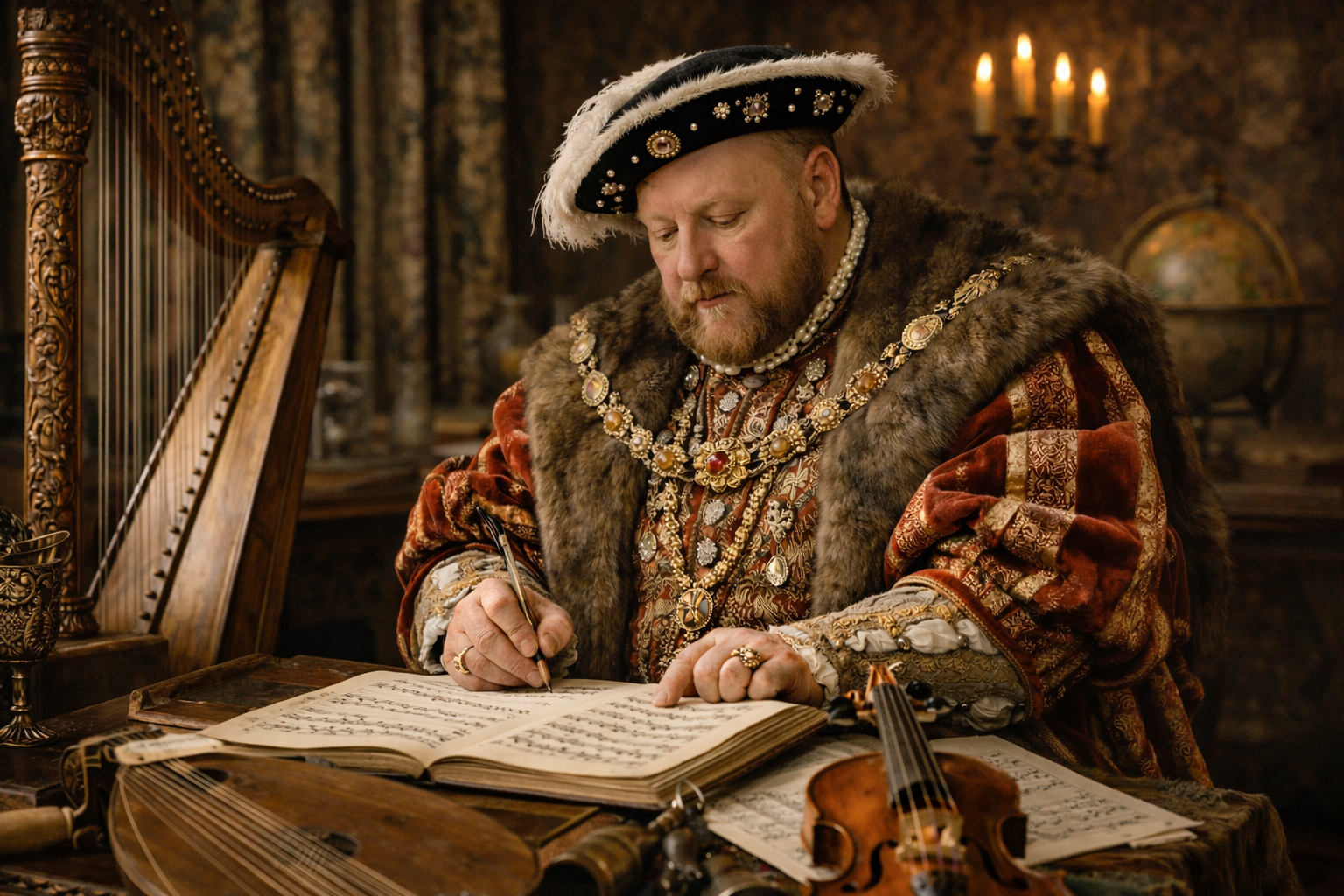
Henry VIII is usually introduced the way storms are: with thunder. Six wives. A severed Church. The slow grind of executions. The famous portrait: broad as a gatehouse, staring down the viewer as if the laws of nature are optional.
But the young Henry did not begin as a butcher of marriages and ministers. He began as something closer to a Renaissance prince in the brightest, most literal sense: a man formed to be seen. And in that world, music was not a pleasant extra. It was education, diplomacy, prayer, flirtation, and social power, all braided into one.
If you want to understand the early Tudor court, you could do worse than to imagine it not as a battlefield but as a stage, thick with torchlight and expectation. And at the center, a handsome young king who could sing, play, and compose, using melody the way others used steel.
A court tuned like an instrument
In Tudor England, music was everywhere at court: in chapels, halls, private chambers, and ceremonial entries. It was the soundscape of power. A king who could perform was not merely entertaining himself. He was demonstrating cultivation, control, and charisma, the same virtues a court expected in arms, language, and dance.
Henry’s court, especially in the earlier decades, leaned hard into this ideal. The evidence is not just anecdotal or romanticized later gossip. It is documentary: inventories, manuscripts, and surviving music books that preserve what was sung and played, and in what style.
One of the most important sources is the so-called Henry VIII Manuscript (British Library, Additional MS 31922), a major early Tudor songbook that includes numerous pieces attributed to Henry himself and distinguishes those pieces by explicit ascription to “The Kynge H. VIII.”
That matters because attribution is often the weak hinge in “royal artist” stories. Here, the manuscript tradition makes a real effort to signal which works were understood as the king’s.
The king who actually wrote songs
Modern readers are used to monarchs consuming art like a luxury good. Henry did that too, lavishly. But he also participated.
Scholarly work on the lyrics and musical attributions in the Henry VIII Manuscript shows a body of songs and texts linked to Henry in the manuscript’s own identifying practices, with “Pastime with Good Company” singled out as an unusually widely disseminated example.
This is where we meet Henry not as the later tyrant but as the court’s leading man: writing in the idiom of chivalric sociability, where the “good company” of the hall is half virtue and half advertisement. The lyric persona is genial, confident, and public-facing. It is music as monarchy: the king presenting himself as the ideal companion, the ideal host, the ideal aristocrat who makes pleasure look like principle.
It is worth pausing on the historical irony. Pastime with Good Company celebrates moderation and cheerful fellowship, a vision of the good life that sits awkwardly beside the later king’s paranoia and cruelty. But that contrast is the point. Henry’s reign is, among many other things, a long story of a man becoming unlike his own early performance.
“Pastime with Good Company”: propaganda you can dance to
Henry’s best-known song, “Pastime with Good Company”, survives in the Henry VIII Manuscript and became famous well beyond the immediate courtly moment that produced it.
It is not “propaganda” in the crude modern sense. It does not shout policy. Instead, it does something subtler: it frames pleasure as moral, and sociability as identity. In a world where reputation was currency, and the court was a pressure cooker, a song like this is a social signature.
The Tudor court loved this kind of thing because it made hierarchy feel like harmony. Everyone has a part, literally. In that sense, polyphonic music is an almost too-perfect metaphor for court politics: separate lines, carefully controlled, creating a single glittering surface.
Instruments and the royal ear
The claim that Henry played multiple instruments is not some Victorian embroidery stitched onto a famous name. The musical world around him was large, professionalized, and documented. And after Henry’s death, the crown’s possessions were inventoried in sweeping detail, including extensive holdings of instruments maintained in royal spaces.
A major scholarly thesis devoted to the musical instruments at Henry VIII’s court emphasizes how documentary evidence, especially the 1547 inventory tradition and related sources, reveals both the scale of the court’s musical resources and the shift toward fashionable “renaissance” ensembles.
That doesn’t prove Henry personally played every instrument in the building, but it places him inside a court whose musical culture was unusually rich, with instruments treated as part of the machinery of magnificence.
And we also have a vivid visual window into how Henry wanted musical kingship imagined: the Psalter associated with Henry VIII (British Library, Royal MS 2 A XVI) contains imagery of Henry with a harp, cast in the role of a David-like figure, with his jester nearby.
This is not a candid snapshot. It is symbolic. But symbolism is evidence of something real: Henry’s desire to be seen as both ruler and performer, warrior and musician, a sacred king who could be framed in the music-soaked biblical tradition of David.
Catherine of Aragon and the early courtly love world
The idea that Henry wrote love songs for Catherine of Aragon fits the cultural logic of their early years. Their marriage (1509) began with genuine optimism and political purpose, and courtly entertainments were part of how that optimism was staged.
What we can say securely is this: Henry’s lyrics in the manuscript belong to a courtly tradition where love, virtue, youth, and reputation are performed in semi-public forms, often through multi-voice song. Scholarly analysis of Henry’s lyric persona emphasizes performance situations that are not intimate whispers but formalized, social music-making, designed for display.
So, could a song have been aimed at Catherine, or sung in a context meant to flatter her? Very plausibly. Can we attach a firm label reading “for Catherine” to a specific surviving piece without sliding into wishful romance? Much harder, unless the text or context explicitly anchors it.
Henry’s early court was a place where affection, politics, and spectacle mixed so thoroughly that separating them is like trying to separate wine from water after the banquet is over.
The myth of “Greensleeves” and why it clings to Henry
No discussion of Henry VIII and music escapes the gravitational pull of “Greensleeves.” It is widely and confidently misattributed to Henry in popular culture, mostly because people cannot resist the story: the king as lovelorn composer, scratching out a melody for a woman who refuses him.
The problem is that the documentary trail points after Henry’s lifetime. “Greensleeves” appears in late Elizabethan print culture, with ballads registered in 1580 and subsequent appearances soon after, placing it decades beyond Henry’s death in 1547.
Why does the myth persist? Because it gives Henry an easy romantic mask: the sensual king with a lute, yearning beautifully. It is the softer Henry we want to believe existed continuously, even when the historical record shows him hardening into something else.
But here’s the more interesting truth: we do not need “Greensleeves” to prove Henry’s musicality. We have better evidence, closer to the king himself, embedded in early Tudor manuscripts and scholarly work that takes attribution seriously.
Music as a clue to the young Henry
So what does Henry’s musical life mean?
It means that the king who later frightened Europe began as a man eager to charm it. Music was one of his languages of rule. It helped him embody the fashionable ideal of the cultivated prince. It helped him command a room without drawing a sword. It helped him make authority feel like joy.
And it complicates the caricature. Not by absolving him. Not by turning tyranny into “but he had hobbies.” It complicates him because it reminds us that the brutal king was once a brilliant young performer, trained to dazzle, and capable of artistry that still survives on the page.
There is a temptation, when faced with Henry VIII, to flatten him into appetite and rage. History is often tidier when we do that.
But the manuscripts refuse tidiness. Somewhere in the early 1500s, in a court thick with voices, a young king helped shape a song that praised “good company,” and for a moment, he sounded like the man he wished to be.