
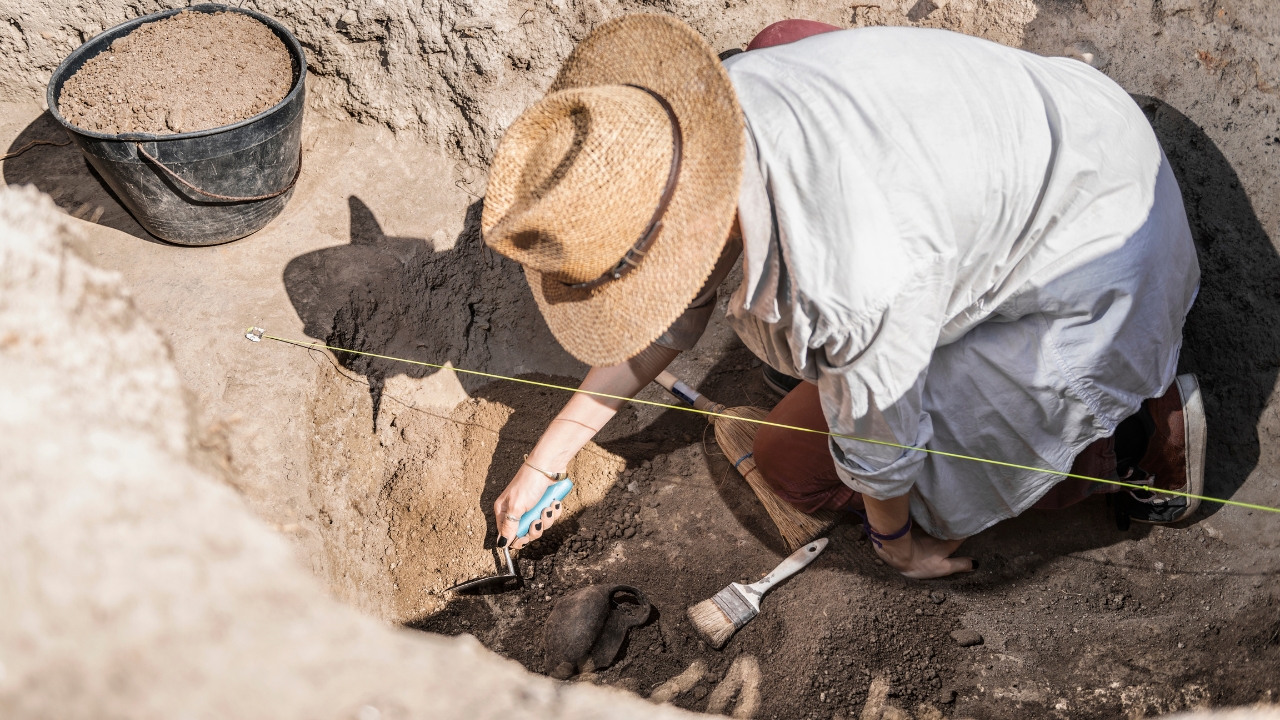
Archaeologists have uncovered more than 800 artifacts—including ornate cauldrons, elaborately decorated horse harnesses, and ceremonial weapons—buried in a field near the village of Melsonby. The items, dating to the first century C.E., are being hailed as one of the most significant Iron Age finds in the history of the United Kingdom.
The discovery was first made in December 2021 by a local metal detectorist, Peter Heads, who recognized that he had stumbled onto something extraordinary. He quickly contacted archaeologist Tom Moore of Durham University, setting in motion a large-scale excavation funded by Historic England. Over the next three months, researchers carefully unearthed a stunning collection that is now reshaping our understanding of wealth, trade, and status in ancient Britain.
Among the most notable items are 14 horse harnesses, believed to have adorned chariots or wagons. Their intricate decorations include colorful glass and even Mediterranean coral—materials that suggest extensive trade connections and the high status of the hoard’s original owner, likely a member of the Brigantes tribe, which dominated northern England at the time.
Also discovered: iron tires, vehicle parts, and a massive cauldron that may have been used for mixing wine—indicating ceremonial or communal use. Researchers believe these items may represent the first evidence of four-wheeled wagons in Iron Age Britain.
Interestingly, many objects had been intentionally burned or broken—a practice believed to be part of ritual destruction, possibly as part of a funerary ceremony. No human remains were found, but the scale and care of the burial suggest a deliberate act of symbolism.
“This is not just discarded equipment,” says Moore. “These items were purposefully destroyed and buried, likely as part of a ritual practice—something we often see in Iron Age culture, but rarely at this scale.”
The Melsonby hoard, as it is now called, is also challenging long-held assumptions about the economic disparities between northern and southern Britain during the Iron Age.
“They challenge our way of thinking and show the north is definitely not a backwater,” Moore told the Guardian. “It is just as interconnected, powerful and wealthy as Iron Age communities in the south.”
The entire collection is estimated to be worth £254,000 (about $330,000), and efforts are underway to ensure it stays in the UK. The Yorkshire Museum is launching a fundraising campaign to acquire the artifacts, and some pieces are already on display for the public to view.
“This discovery gives us a window into a rich, complex world of Iron Age Britain,” says Andrew Woods, the museum’s senior curator. “We now have an opportunity to explore who these people were, how they lived—and how they connected to the broader ancient world.”