
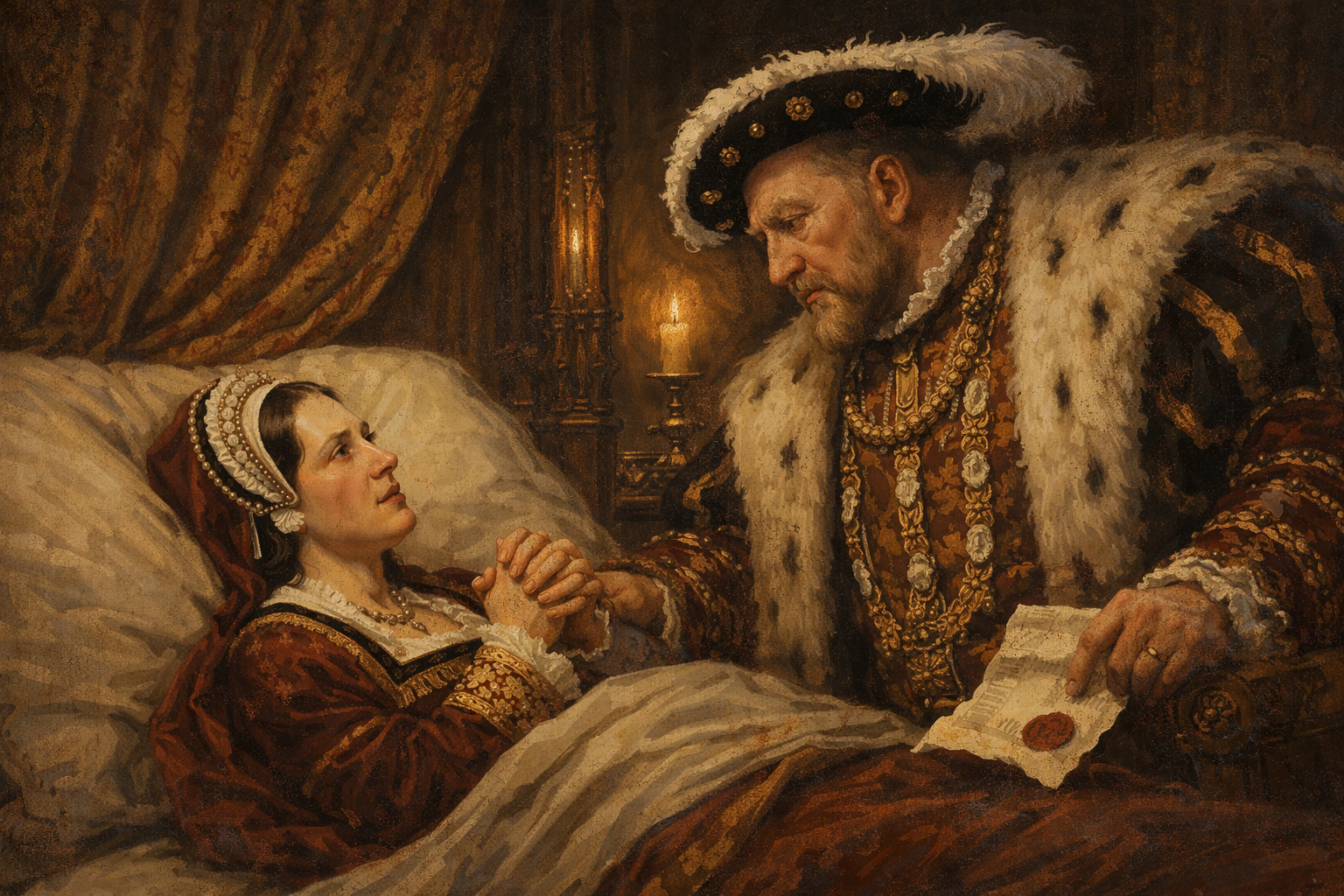
By 1546, the Tudor court had become what it always threatened to become: a place where a whispered allegation could travel faster than truth, and where a signature from an aging king could turn a wife into a prisoner before supper.
Henry VIII was fifty-five, and his body was failing in public. The leg ulcers, the chronic pain, the unstable temper, the long drift from athletic prince to suspicious monarch, all of it narrowed the world around him. In such a court, politics did not merely happen around the royal marriage. Politics entered the marriage, sat at the table, listened at the door, and then repeated everything with just enough distortion to get someone killed.
Catherine Parr, Henry’s sixth and final wife, understood this environment the way sailors understand weather. She had survived two marriages before Henry (and the intricate dangers of the Pilgrimage of Grace-era north through her Latimer household), and she arrived at the throne not as a romantic innocent but as a practiced reader of men and motives. She was also, inconveniently for her enemies, intelligent, literate, and spiritually curious. In Henry’s England, that could be as dangerous as carrying a dagger.
A Queen in a Court at War With Itself
Catherine married Henry in July 1543 and quickly became more than ornamental. She maintained unusually close relationships with Henry’s children and played a stabilizing role in the household, and in 1544 Henry appointed her regent while he campaigned in France. That appointment mattered: it placed her inside the machinery of authority, if only temporarily, and it advertised trust. Trust, in a Tudor court, invited counterattack.
Religiously, England in the mid-1540s was not simply “Catholic vs. Protestant.” It was a tense, shifting mosaic of reformers, traditionalists, and political opportunists using theology as both conviction and weapon. Henry had broken with Rome, but he was no simple Protestant champion. His regime could authorize an English Bible and also persecute “heresy.” The middle ground was crowded with people who believed, feared, maneuvered, and lied in equal measure.
Catherine leaned toward reform. She sponsored and protected reform-minded scholars and clerics; she gathered around her a circle of women who read and discussed evangelical texts; and she did something even riskier: she sometimes argued theology with the king himself. Modern readers tend to imagine these as salon-style debates, refined and philosophical. The sources suggest something more volatile: a queen who enjoyed religious discussion and a king who enjoyed being right. The danger was not merely that Catherine held “Protestant sympathies,” but that she could sound, to her opponents, like a person instructing the Supreme Head of the Church of England. Even reformers knew that was playing with fire.
Historic Royal Palaces, drawing on court evidence and the broader context of 1546, notes that conservatives searched rooms associated with Catherine’s ladies for suspect books and pursued lines of accusation that had already produced victims in that same year.
The Conservatives Make Their Move
The conservative faction that turned its attention to Catherine included men who had survived Henry’s reign by understanding how to feed the king’s suspicions. Chief among them was Stephen Gardiner, Bishop of Winchester: brilliant, hard-edged, and committed to traditional doctrine, but also a political operator who knew the value of the king’s ear. Gardiner did not need Catherine to be formally tried and convicted in open court to destroy her. He only needed Henry to believe she was a threat.
The mechanics of this kind of coup were familiar:
- Create a cloud of insinuation around the target.
- Find or manufacture “evidence” that can be presented as safeguarding the king.
- Move quickly, before sympathy can organize or the king’s mood changes.
One reason 1546 mattered so much is that it was also the year of Anne Askew’s final arrest, interrogations, torture, and execution. Askew was a committed evangelical who refused to concede on key doctrinal issues, particularly around the Eucharist. Her case became a conservative hunting ground because it offered a tempting possibility: extract names, tie those names to the queen’s circle, and then frame Catherine as the center of a reformist infection inside the palace.
Historic Royal Palaces explicitly connects the conservative effort to searches for books, interrogations, and the pressure campaign around Gardiner’s evidence. A scholarly treatment of Askew’s “heresy-hunting” context also underscores how bitter and ideologically charged these interrogations were, and how the specter of sacramentarian heresy fueled attempts to control interpretation and belief.
In other words, Catherine’s danger was not theoretical. The court had just demonstrated, in real time, how far it would go.
The Warrant: A Piece of Paper With the Weight of an Axe
At some point in this sequence, Henry signed a warrant for Catherine’s arrest. The broad outline is widely attested in later narratives, and it appears in reputable modern syntheses, including Smithsonian’s discussion of the “Firebrand” story and its historical basis: conservatives compiled evidence, Henry approved a warrant, and the queen learned of it through the warrant’s mishandling.
Even without treating every dramatic flourish as courtroom-grade certainty, the essential point is simple and chilling: the king’s will, committed to paper, could have moved Catherine from queen-consort to Tower prisoner with almost no procedural friction.
British History Online’s publication of Letters and Papers, Foreign and Domestic, Henry VIII provides a documentary backbone for this period, offering the administrative texture of 1546 that sits behind the better-known narratives. It reminds us that Tudor government ran on memos, warrants, instructions, and enforcement. The machine existed. The question was whether it would be aimed at the queen.
Fortune, or a Sympathizer, Intervenes
Here the story turns on accident, which is to say: on the most human variable of all. The warrant was reportedly dropped, found, and brought to someone who ensured Catherine learned of it. Smithsonian recounts this basic sequence and quotes Foxe’s depiction of Catherine’s distress when she realized what was happening.
John Foxe is not a neutral witness. His Acts and Monuments is a fiercely Protestant work, written with a polemical purpose, meant to frame English reform as both providential and persecuted. That means a careful historian treats Foxe as a source, not a judge. He is valuable precisely because he reveals what later Protestants wanted remembered, and because he sometimes preserves details and emotional textures absent elsewhere. But he also dramatizes, sharpens villains, and edits reality into a morality play.
So: did Catherine receive a warning because the warrant literally slipped from a hand, or because someone inside the council leaked it deliberately? The “dropped paper” version may be true, or it may be a later simplification that makes the story cleaner and more cinematic. Either way, the core truth remains: Catherine got early warning, and that warning gave her a narrow window to act.
Catherine’s Counterstroke: Humility as Strategy
Catherine did not respond like a person who expected justice. She responded like a person who knew the rules of Henry VIII.
She went to Henry and reframed the entire matter. If she had argued theology with him, she did not present it as an assertion of her own learning. She presented it as something done for his benefit: to divert him from pain, to engage his mind, to learn from his wisdom. The genius of that approach was not the flattery alone, though it certainly helped. It was that it restored the hierarchy Henry insisted upon: the king as teacher, the queen as attentive student.
According to the account preserved in later tradition and repeated in reputable modern summaries, this explanation worked. Henry, soothed and pleased, forgave her. The conservatives, having loaded the gun, suddenly found the king had turned it away.
The Arrest Party Arrives, and Henry Explodes
The next day, the officials tasked with arresting Catherine appeared, apparently unaware that the king had reconciled with her. That ignorance is entirely plausible. Tudor politics moved quickly, but it also moved through compartments. A warrant could be “secret” in intent yet still operationally exposed.
The scene that follows is one of those moments you can picture too easily: armed men arriving to seize a queen, the court holding its breath, Catherine’s face controlled because it has to be, and Henry suddenly raging that anyone would dare touch his wife after he has chosen to spare her.
Smithsonian’s account preserves the essential point: the arrest attempt collapsed because Henry intervened, and the men were dismissed in humiliation. Historic Royal Palaces likewise emphasizes the danger Catherine faced and the conservative effort to secure a warrant, underscoring how close the mechanism came to snapping shut around her.
Whether Henry used the exact insult “knaves” in precisely that moment is the kind of detail that often travels through Foxe and later retellings. It may be accurate; it may be sharpened. But the underlying truth is sturdier than the adjective: Henry repudiated the arrest attempt, and Catherine survived.
Why She Lived When Others Did Not
It is tempting to explain Catherine Parr’s survival as luck plus quick thinking. That is part of it, but it is not the whole.
Catherine survived because she understood three brutal Tudor realities:
Henry’s ego was a political force.
To accuse Catherine of heresy was, implicitly, to accuse Henry of having married badly, chosen poorly, and allowed his household to be subverted. That is not a small thing to insinuate to a man who treated contradiction like treason.
The king’s pain created a hunger for control.
Henry’s physical decline made him more sensitive to anything that looked like disobedience, instruction, or moral superiority. Catherine’s safest move was to perform obedience without surrendering her inner convictions. She did it in the only language Henry reliably respected: deference.
Factional politics always overreached.
Gardiner’s circle gambled that Henry’s fear of heresy would outweigh his attachment to Catherine. But they pushed at a moment when Henry could still be emotionally managed. Once Catherine offered him a story that preserved his dominance, the conservative plotters were left holding a warrant that had become an insult.
In that sense, Catherine’s survival was not merely personal triumph. It was a case study in how power functioned at the end of Henry’s reign: the king’s mood as law, the court as weapon, theology as pretext, and performance as survival.
After Henry: The Strange Freedom of Being Alive
Catherine outlived Henry, who died in January 1547. In the grim arithmetic of the Tudor marriage market, that alone was victory. She went on to remarry Thomas Seymour, a choice that proved more reckless than her marriage to Henry, and she died in 1548 after childbirth complications. Her survival of Henry did not grant her a long life, but it granted her something rare in the Tudor story: a final chapter not written by executioners.
And perhaps the most sobering detail is this: Catherine Parr’s near-fall was not a dramatic anomaly. It was a logical outcome of a court system designed to turn belief into accusation and accusation into leverage. The paper almost did kill her. It simply arrived on the wrong day.