
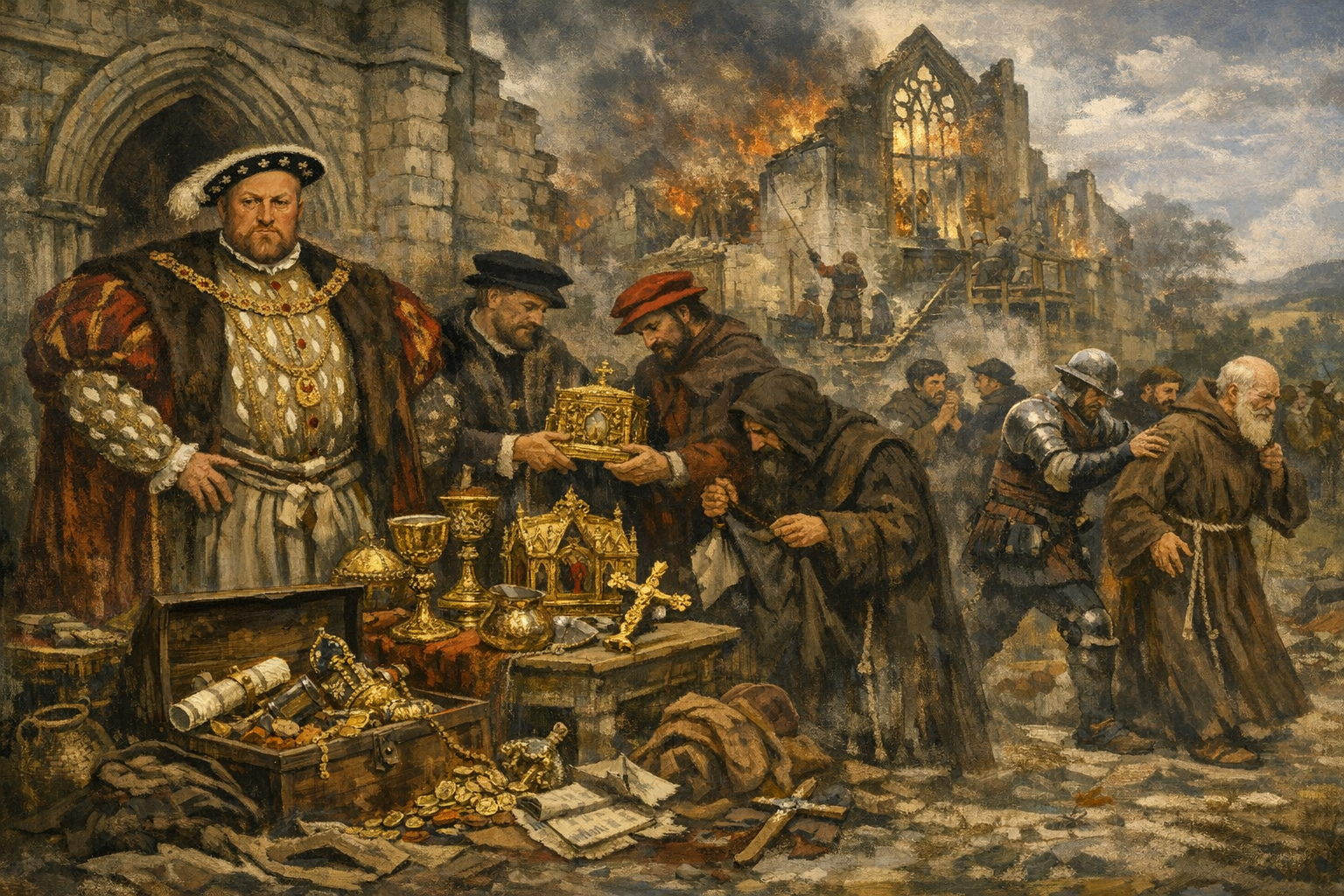
In the early spring of 1536, England’s monastic world still looked, from the outside, like it had for centuries: bells marking the hours, hospitality offered to travelers, alms distributed at monastery gates, and a steady hum of prayer stitched into daily life. Then the Crown came calling, not with the language of devotion, but with ledgers.
Between 1536 and 1540, Henry VIII’s government dismantled England’s religious houses at speed, scale, and finality. More than 800 monasteries, abbeys, priories, and convents were dissolved in a four-year whirlwind that ended a millennium of institutional monastic life. The physical remains would linger as romantic ruins. The social and cultural shockwave would not fade so easily.
The pretext: “abominable living” and the moral narrative
The official story presented to Parliament and public opinion was moral reform. The famous preamble to the 1536 legislation for dissolving the smaller houses thundered that “manifest sin, vicious, carnal and abominable living” was “daily used and committed” among certain communities.
This was not merely a bit of Tudor finger-wagging. It was a political instrument. If a policy is going to strip ancient institutions of property, dignity, and legal standing, it helps to argue that those institutions deserve it. Historians have long noted the gap between the sweeping accusation and the uneven reality of monastic life on the ground, where many houses were neither decadent nor collapsing into chaos. (That tension, between propaganda and lived life, is part of what makes the dissolution feel so modern.)
The machinery: audit, seizure, administration
Before England could be “reformed,” it had to be measured. Royal surveys and visitations produced the information the state needed to act: what each house owned, what it earned, what plate it held, what rents it collected. The National Archives’ dissolution guide captures the nature of the surviving paper trail: a bureaucratic campaign as much as a spiritual revolution.
In 1536, the Court of Augmentations was founded to manage the torrent of property flowing into the Crown’s hands. This is one of the most telling features of the whole episode. Henry did not simply smash monasteries. He built a state apparatus to digest them.
And digest them it did.
The prize: land, wealth, and the largest transfer of property in generations
The monasteries were not just religious communities. They were major landowners and economic hubs. Modern quantitative work points to the scale: on the eve of dissolution, monasteries, alongside other ecclesiastical institutions, controlled land on the order of a quarter (or more) of England’s landholding, and the monastic sector alone constituted a massive block of assets ripe for expropriation once the Crown claimed legal supremacy.
The wealth came in different forms. There was the long-term value of land and rents, and there was immediate cash from movable goods: plate, jewels, bells, lead, and anything else that could be melted, sold, or repurposed. One economic study summarizes the windfall from such sales as an estimate in the range of roughly £1 to £1.5 million, while also emphasizing how quickly money could vanish once Henry’s wars and ambitions demanded it.
Even if we resist turning this into a single tidy number (Tudor finance refuses to stay tidy), the direction is unmistakable: the dissolution enriched the Crown and, through subsequent sales, enriched a broad swath of the political nation that acquired former monastic land. It was a revolution in ownership.
The human cost: displacement, lost work, broken rhythms
For generations, monasteries had anchored local life. They hired lay servants. They leased land to tenants. They provided charity and occasional medical care. They educated novices and, in some places, maintained schools and book collections. When the houses fell, the consequences were not theoretical.
James G. Clark’s modern synthesis emphasizes how abruptly daily patterns were disrupted when monastic institutions, embedded in local economies and identities, were simply removed. That disruption included something less measurable than land: the loss of cultural memory stored in libraries and archives. Work on the dissolution’s impact repeatedly returns to the destruction and dispersal of books and records, a wound to English historical inheritance that antiquarians tried (only partly) to staunch.
If the Crown’s agents arrived with inventories, many ordinary people experienced the event as subtraction: fewer sources of alms, fewer places of refuge, fewer familiar holy sites, fewer employers. In an age without a modern welfare state, that mattered in ways that could turn anger into action.
Why Henry did it: money, power, and the logic of supremacy
It is tempting, and not entirely wrong, to say Henry did it for the money. The Crown did gain revenue and assets, and the dissolution helped fund government and military projects in a decade when Henry’s strategic anxieties were rising.
But reducing the dissolution to greed alone misses something central about the politics of the 1530s: authority. Once Henry claimed royal supremacy over the English church, institutions that represented allegiance to an older, international religious order were not merely wealthy. They were competitors in legitimacy.
George W. Bernard has argued forcefully that explanations focusing only on finance underestimate the ideological and political dimensions, including Henry’s insistence on royal authority and a broader critique of monastic religion that was not purely fiscal. In other words, the monasteries fell because they were rich, yes, but also because they embodied a kind of independent spiritual corporate life that the new regime viewed as suspect, sometimes even disloyal.
In Tudor England, “reform” often meant centralization.
Northern England ignites: the Pilgrimage of Grace
Nowhere were the monasteries more beloved, and their destruction more inflammatory, than in the north. The backlash erupted in 1536 with the Pilgrimage of Grace, a movement that drew in huge numbers and fused religious and political grievances. Contemporary and later accounts consistently emphasize the rebellion’s demand that the religious houses be restored.
What the rebels wanted was not an abstract constitutional debate. They wanted their world back: their abbeys reopened, their shrines respected, their religious settlement reversed. The Crown, facing a serious crisis, negotiated and promised. Then, when the immediate danger passed, it retaliated.
Britannica summarizes the grim outcome: as the rising fractured and the government reasserted control in early 1537, roughly 220–250 men were executed in the aftermath, including prominent leaders. This was not merely punishment. It was instruction. A regime that could dissolve monasteries could also make a spectacle of force.
What remained when it was over
By 1540, the monastic landscape had been unmade. Some church buildings survived in whole or in part, repurposed for parishes or cathedrals; much else was stripped for valuable materials or left to decay.
The deeper legacy was structural:
- A more powerful Crown, with new administrative machinery and expanded reach into local life.
- A reshaped landowning class, as former monastic estates moved into private hands, binding gentry and nobles to the post-dissolution settlement.
- A cultural amputation, as libraries, archives, and shrine cultures were dispersed or destroyed, narrowing what later generations could know of medieval England from original sources.
Henry VIII is often remembered through the theater of marriages, the drama of executions, the gleam of courtly magnificence. The dissolution belongs in that list, but it deserves a darker framing. It was the moment the state did something that felt impossible: it reached into the oldest institutions in English life and turned them into revenue.
It is hard to walk the ruins of Fountains, Tintern, or Glastonbury without sensing the collision of two Englands. One built on vows, memory, and place. The other built on paperwork, power, and the Crown’s ability to make the sacred negotiable.