
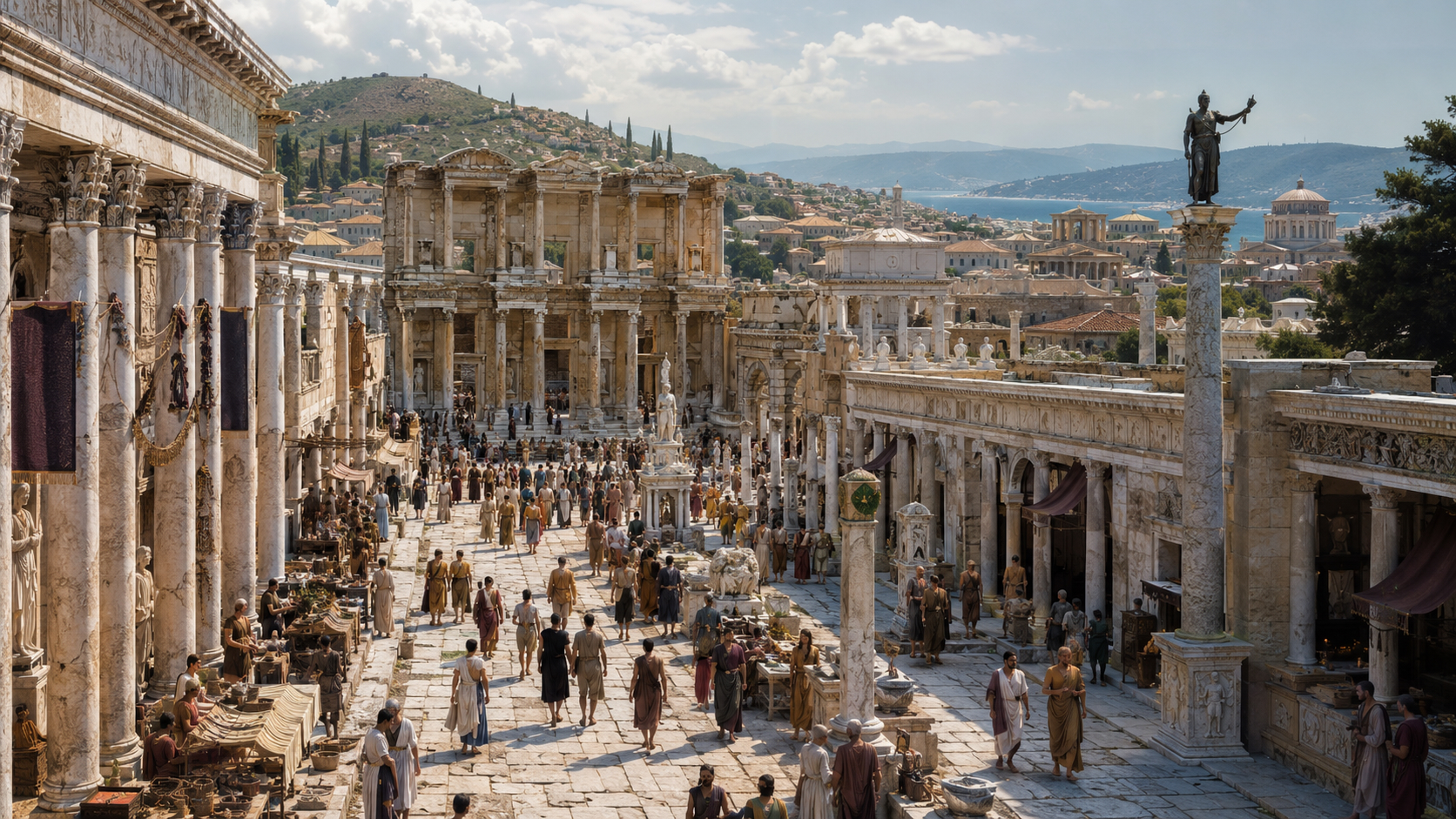
There are cities that rise, cities that fall, and then there is Ephesus, which did something stranger. It moved.
Not once, but again and again, Ephesus followed the sea like a merchant chasing a departing caravan. Its story began in the shifting mouth of the Kaystros River, in western Anatolia, where silt, water, trade, and ambition shaped one of the greatest cities of the ancient Mediterranean. Today its ruins stand near Selçuk in modern Turkey, inland from the Aegean. In antiquity, however, Ephesus was a harbor city, a place where ships, pilgrims, philosophers, merchants, imperial officials, and Christian bishops arrived with news from the wider world. UNESCO describes Ephesus as a settlement landscape shaped over time by the westward retreat of the coastline, with successive settlements and harbors following the changing shore.
Long before marble libraries and Roman theaters, people were already living in the region. Archaeological evidence from Çukuriçi Höyük, just southeast of the later Hellenistic and Roman city, reaches back to the Neolithic period, the seventh millennium BCE. The site became a trading hub between the Aegean and Central Anatolia, and by the second millennium BCE the region appears in Hittite sources, probably as Apaša, a major Anatolian center that many scholars connect with the later Ephesus.
The Greek Ephesus that later writers remembered emerged gradually after about 1000 BCE, when Greek-speaking groups moved into western Asia Minor. As with many ancient cities, its beginnings were wrapped in foundation legends. The Greeks told of Androklos, an Athenian prince guided by an oracle, but archaeology gives us the steadier evidence: early Greek material beneath later urban layers, settlement around Ayasuluk Hill, and above all the sanctuary of Artemis, which became the spiritual heart of the city.
And what a heart it was. The Artemis of Ephesus was not simply the huntress of mainland Greek imagination. She carried older Anatolian associations, a great motherly and protective presence rooted in local religious traditions. By the seventh century BCE, her sanctuary already had a monumental building. In the sixth century BCE, under the patronage of the Lydian king Croesus, a new temple rose there, vast, gleaming, and famous. After a fire in 356 BCE, the Ephesians rebuilt it on an even more magnificent scale. Ancient writers came to regard the Artemision as one of the Seven Wonders of the World, and pilgrims came from across the Mediterranean to honor the goddess.
Ephesus entered a new chapter around 300 BCE under Lysimachus, one of Alexander the Great’s successors. He refounded the city between the ridges of Bülbüldağ and Panayırdağ, imposing a planned Hellenistic city with a grid and an immense fortification circuit. The Austrian Archaeological Institute notes that this refoundation involved forced resettlement from nearby communities and left behind a roughly nine-kilometer wall running across the mountain slopes.
Then came Rome, and Ephesus became grander still.
When Asia Minor passed into Roman control in 133 BCE, Ephesus eventually became the capital of the province of Asia, one of the richest provinces in the empire. Under Roman rule, the city expanded into a true metropolis. Aqueducts brought mountain water into the urban center. Public fountains, bath complexes, marketplaces, colonnaded streets, temples, and civic monuments announced the wealth of local elites and the reach of imperial power. The city’s Upper Agora held political buildings such as the Bouleuterion and Prytaneion, while the lower city near the harbor pulsed with trade.
Curetes Street became one of the great urban avenues of the Roman East. It did not follow the strict grid of the Hellenistic plan because it had older sacred and processional roots. By the imperial period, it was lined with monuments, fountains, honorific structures, and the houses of the wealthy. To walk there in the second century CE would have been to move through a stone theater of status: inscriptions, statues, marble facades, flowing water, and the constant reminder that Ephesus was not provincial in the modern sense. It was a capital, a city that mattered.
At the end of that street rose the Library of Celsus, perhaps the most famous surviving monument of ancient Ephesus. Built in the early second century CE by Tiberius Julius Aquila in honor of his father, Tiberius Julius Celsus Polemaeanus, it was both a public library and a tomb. Its reconstructed facade still dazzles visitors, but the building was more than a beautiful front. According to the Austrian Archaeological Institute, it once held around 10,000 book rolls on two floors, while the burial chamber of Celsus lay behind the library, with his sarcophagus still in its original position.
Nearby stood the Great Theatre, one of the largest in the ancient world, with seating for about 22,000 people according to the Austrian Archaeological Institute. It hosted performances, assemblies, gladiatorial spectacles, and animal hunts. It also gave Ephesus one of its most famous moments in early Christian memory. The Acts of the Apostles describes a riot sparked by artisans who feared that Paul’s preaching threatened the trade in Artemis-related shrines. The crowd, according to Acts, gathered in the theater and cried out for Artemis. Whether one reads the passage devotionally or historically, the setting is plausible: a huge civic theater in a city whose economy, identity, and religious prestige were bound to the goddess.
Ephesus was not merely a city of marble. It was a city of households, workshops, kitchens, slaves, freedpeople, magistrates, priests, widows, merchants, sailors, philosophers, and physicians. The Terrace Houses, built into the slope near Curetes Street, reveal the life of the elite in striking detail. Wall paintings, mosaics, marble paneling, and carefully arranged domestic spaces show the comfort and display culture of the city’s upper class. UNESCO specifically highlights Terrace House 2 as evidence for elite Roman domestic life in Ephesus.
Religion in Ephesus changed slowly and dramatically. Artemis dominated the city for centuries, but by late antiquity Christianity had become central to Ephesian identity. The city became important to Christian pilgrimage, associated with the Church of Mary, the Basilica of St. John on Ayasuluk Hill, and other sacred sites. Two major church councils were held at Ephesus, in 431 and 449 CE. The Council of 431, convened during the reign of Theodosius II, became one of the defining councils of early Christianity, especially in the controversy over Nestorius and the title Theotokos, “God-bearer,” for Mary.
Yet even sacred prestige could not fully rescue the city from geography. The same river landscape that had made Ephesus rich slowly worked against it. The Kaystros carried sediment into the harbor. The coastline shifted. The port silted. A city built on access to the sea found itself fighting the land itself. Roman and later authorities attempted to maintain harbor access, but over time the city’s economic lifeline weakened.
Ephesus did not vanish in a single catastrophe. It diminished by stages. The third century brought imperial crisis and natural disasters. Late antiquity brought a smaller but still prosperous Christian city. After the seventh century, the urban center contracted further, and medieval life shifted toward Ayasuluk, near the old sanctuary and the later Basilica of St. John. By the fourteenth century, the Turkish town of Ayasoluk flourished under the princes of Aydın, while the ancient city below increasingly became a quarry of memory and stone.
Modern archaeology returned Ephesus to the world. Excavations and conservation have been underway for more than 150 years, with the Austrian Archaeological Institute central to the long-term study of the city. John Turtle Wood, excavating for the British Museum in the nineteenth century, discovered the site of the Temple of Artemis, helping reawaken scholarly and public fascination with one of antiquity’s most famous sanctuaries.
To stand in Ephesus today is to see several worlds layered upon one another. The Neolithic mound. The Anatolian goddess. The Ionian city. The Hellenistic plan. The Roman capital. The Christian pilgrimage center. The medieval settlement. Few ancient cities make time feel so physical. Ephesus was not one thing. It was a harbor and a shrine, a market and a theater, a provincial capital and a pilgrimage road. It was a city where Artemis was praised, emperors were honored, books were stored, bishops argued, merchants prospered, and the sea, slowly and without sentiment, withdrew.
The ruins are magnificent, but the deeper story is more human: Ephesus endured because it adapted, and it declined when adaptation could no longer keep pace with the earth beneath it. Its marble remains are not simply the bones of a dead city. They are the record of an ancient community wrestling, century after century, with power, faith, wealth, memory, and nature.