
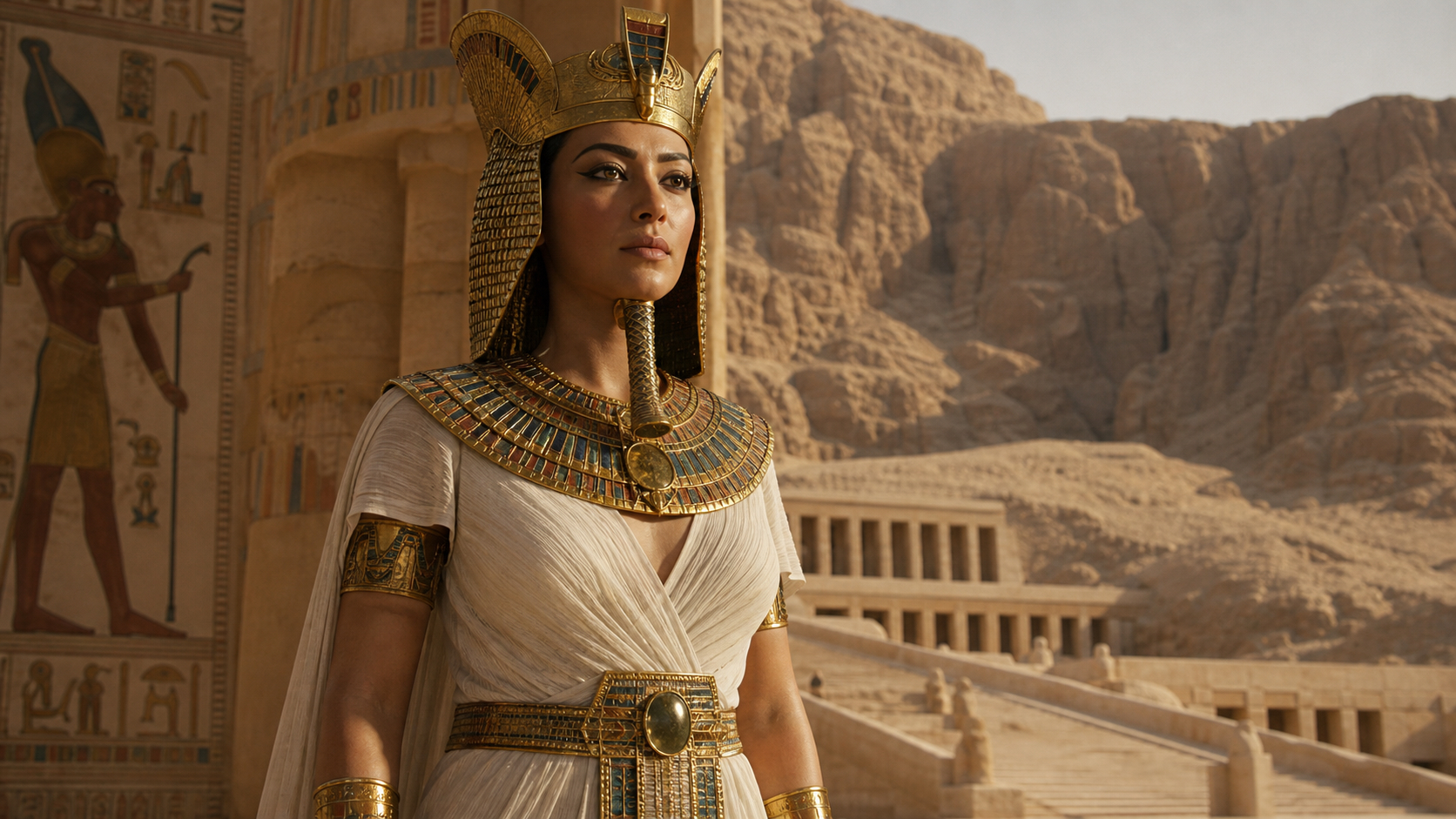
In the limestone glare of western Thebes, where the desert cliffs rise like a wall against eternity, Hatshepsut built herself a monument that did not whisper. It announced.
Her temple at Deir el-Bahri, with its clean terraces and long colonnades pressed against the mountain, was not merely a tomb chapel, not merely a stage for ritual, not merely a work of royal vanity. It was an argument in stone. The woman who commissioned it had begun life within the expected boundaries of Egyptian queenship, as daughter, wife, priestess, and regent. Then, sometime in the early years of the reign of the boy-king Thutmose III, she stepped across a line few women in Egyptian history had crossed. Hatshepsut did not simply rule beside a king. She became one.
The Metropolitan Museum of Art, whose excavations recovered many of her shattered statues, calls her “the first important female ruler known to history” and dates her reign to roughly 1473 to 1458 BCE, during Egypt’s 18th Dynasty. She ruled first as regent for her young stepson and nephew Thutmose III, then as his co-ruler, in a period remembered not for conquest on the scale of later pharaohs, but for prosperity, building, and the careful making of royal legitimacy.
Hatshepsut was born into the golden machinery of the early New Kingdom. Her father, Thutmose I, had helped secure Egypt’s imperial position after the old trauma of foreign rule in the north. Her mother, Ahmose, held the prestige of a Great Royal Wife. The world into which Hatshepsut came was one in which blood mattered, ritual mattered, titles mattered, and the gods were not decorative presences but political realities. To be near Amun of Thebes, the great god whose cult had risen with the dynasty, was to stand near the source of royal power.
As a young woman, Hatshepsut married her half-brother Thutmose II, the ordinary and dynastic thing to do in the royal house. She bore him a daughter, Neferure, but no son. When Thutmose II died, the throne passed to a child, Thutmose III, born to a secondary wife named Iset or Isis. Hatshepsut became regent, and at first nothing about this was revolutionary. Queens had guarded thrones before. Women of the early 18th Dynasty, especially Ahmose-Nefertari, had already exercised conspicuous religious and political influence. The office of “God’s Wife of Amun,” held by royal women, carried ritual authority and probably economic power through its estates. Egyptologist Gay Robins notes that Hatshepsut is attested with the titles “king’s principal wife” and “god’s wife,” and that after Thutmose II’s death an official biography says Hatshepsut “controlled the affairs of the land.”
There, in that phrase, the story tightens. A woman “controlled the affairs of the land,” and the land was Egypt.
For several years she governed in the name of the boy. Then the language around her began to change. Her images changed. Her titles changed. The queen who had stood beside power began to stand inside it. By the end of Thutmose III’s seventh regnal year, Hatshepsut had adopted the full titulary of a pharaoh. She and Thutmose III were co-rulers, but she was, as Britannica puts it, “very much the dominant king.”
This was not a costume drama. It is tempting, from the distance of the modern world, to describe Hatshepsut as a woman disguising herself as a man. That misses the Egyptian logic. Kingship in ancient Egypt was not merely a job held by a male body. It was a sacred office with its own visual grammar. A pharaoh wore certain crowns, carried certain names, performed certain rites, and appeared in art according to conventions older than almost every living institution in the ancient world. When Hatshepsut’s formal images began showing her with the nemes headcloth, shendyt kilt, and sometimes the ceremonial false beard, she was not pretending. She was speaking the language of kingship.
Britannica makes the point plainly: to dismiss her kingly representation as an attempt to pass herself off as a man is to misunderstand Egyptian art, which represented not simply what a person looked like, but what a person was meant to be within cosmic order. In becoming visually “king,” Hatshepsut made a claim about what Egypt needed to see when it looked at its ruler.
Still, claims require support. Hatshepsut anchored hers in three places: blood, god, and achievement.
Blood came first. She was the daughter of Thutmose I and Ahmose, a woman of senior royal rank. In a court where pedigree could quiet objections, that mattered. God came next. At Deir el-Bahri, she carved into the walls a divine birth narrative in which Amun-Re came to her mother, Ahmose, and ordained Hatshepsut’s future rule. The National Museum of Egyptian Civilization describes this divine birth cycle as a deliberate statement of legitimacy, meant to show that her rule had been preordained.
Achievement supplied the third proof. Hatshepsut built.
At Karnak, the great religious heart of Thebes, she added the Red Chapel, remodeled parts of her father’s work, and raised obelisks for Amun. Obelisks were not modest objects. They were shafts of divine sunlight made stone, quarried, transported, polished, inscribed, and hoisted upright by the labor of a kingdom. To erect them was to demonstrate resources, command, piety, and nerve. Robins notes that while Hatshepsut was still regent, she had a pair of obelisks quarried and erected at Karnak, an act normally reserved for kings, thereby reinforcing her position as Egypt’s effective ruler.
Her most famous building, however, rose on the west bank at Deir el-Bahri. It was called Djeser-Djeseru, the “Holy of Holies.” The site was a stroke of genius. Behind it towered the Theban cliffs, severe and theatrical. Nearby stood the older mortuary temple of Mentuhotep II, the Middle Kingdom king who had reunited Egypt centuries before. Hatshepsut’s architects, probably under the direction of the powerful official Senenmut, borrowed from that older setting and surpassed it with a temple of terraces, ramps, chapels, gardens, painted reliefs, and political storytelling. The Met’s Heilbrunn Timeline identifies Hatshepsut as the most powerful female ruler of pharaonic history and notes that her funerary temple in western Thebes was one of the defining works of the New Kingdom’s artistic flowering.
The temple told visitors what Hatshepsut wanted remembered. There was the divine birth. There were offerings to gods. There was family memory. And there was Punt.
The expedition to Punt may be the most vivid episode of her reign. Egyptian ships sailed southward, probably along the Red Sea routes, to a land that has not been securely identified but is often associated with the southern Red Sea region, perhaps in the Horn of Africa area. The reliefs at Deir el-Bahri show the marvels brought home: gold, ebony, ivory, animal skins, baboons, incense, and, most famously, living myrrh trees, which were planted in the temple gardens.
Imagine the scene as Hatshepsut’s artists wished it seen: ships heavy with tribute and trade goods, sailors bent under exotic cargo, incense trees with their roots bound for transplanting, the scent of myrrh joining the dry Theban air. The queen-king did not need to be shown drenched in battlefield blood to prove greatness. She made abundance itself a form of conquest. Her reign was not wholly without military action, since scenes suggest activity in Nubia, but her fame rests on restoration, trade, piety, and monumental construction rather than on the imperial war-making later associated with Thutmose III.
Around her stood able servants of the state. Senenmut, steward, architect, and tutor to Hatshepsut’s daughter Neferure, became the most famous of them. His rise was extraordinary. Later gossip and modern speculation have often made him Hatshepsut’s lover, but that remains unproven. The evidence shows a powerful official closely tied to the royal household and building program, not a confirmed romance. Here the historian has to resist the easy story. Hatshepsut’s life is dramatic enough without inventing whispers to explain her power.
And what of Thutmose III, the boy whose throne she had protected and then overshadowed?
For a long time, the standard tale made him the resentful stepson, waiting in the wings for revenge. The image is irresistible: the warrior king, humiliated in youth, smashing the memory of the woman who had kept him from sole rule. There is truth in the destruction, but motive is more complicated than melodrama. Hatshepsut’s statues were broken. Her name was erased from monuments. Her images were attacked. The Met notes that about twenty years after her death, Thutmose III had her statues smashed and her name and image erased from monuments, although the reasons remain unclear.
Recent scholarship has been more cautious. The Egypt Exploration Society notes that older interpretations often leaned heavily on assumptions about gender and personal hostility, while newer work studies the erasures as a complex historical problem. Hatshepsut’s monuments suffered multiple phases of damage, including later religious iconoclasm, restoration, re-carving, and reuse. Even the erasure of her cartouches was not always total, partly because divine names such as Amun and Re formed parts of her royal names and could not be treated carelessly.
The most persuasive explanation is not simple hatred, but dynastic housekeeping hardened into stone. Thutmose III may have sought to clarify the royal line as male succession from Thutmose I to Thutmose II to Thutmose III, smoothing away the uncomfortable fact that a woman had occupied kingship between them. Britannica notes that later Egyptologists moved away from the revenge theory and argued that the erasures may have been intended to secure the succession narrative without a female interruption. It also notes still newer interpretations that some statue damage may have involved ritual deactivation or later processes rather than one clean campaign of personal vengeance.
Hatshepsut disappeared from memory, but not completely. That is the remarkable thing. Erasure rarely erases as cleanly as rulers hope. Stone keeps secrets badly. Broken statues leave fragments. Chiseled names leave scars. A missing king in a list can be as eloquent as a name preserved in gold.
When hieroglyphs were deciphered in the 19th century, scholars could finally read the inscriptions at Deir el-Bahri and begin reconstructing the woman behind the damaged cartouches. At first, the evidence confused them: female names, kingly images, altered monuments, a ruler who seemed to be both queen and pharaoh. Slowly, the shape of the reign emerged. Hatshepsut had not been an aberration tucked into a minor corner of Egyptian history. She had been one of the most successful rulers of the 18th Dynasty.
Her greatness lay not in ruling “like a man,” but in understanding the machinery of power better than many men who inherited it easily. She knew the throne required theology, ceremony, public works, elite cooperation, and visible prosperity. She knew that legitimacy was not a private conviction but a public performance repeated in stone, incense, ritual, and gold. She also knew, perhaps better than anyone around her, that Egypt could accept the impossible if the impossible was made to look ancient.
Stand before her seated statue today, and the contradiction dissolves. There is the king’s headcloth. There is the royal kilt. There is the body of a woman rendered within the conventions of pharaonic power. The hands are broken. The face is calm. The statue has survived precisely because it was damaged, buried, rediscovered, and reassembled. So too with Hatshepsut herself.
The chisel came for her name. The desert gave it back.