
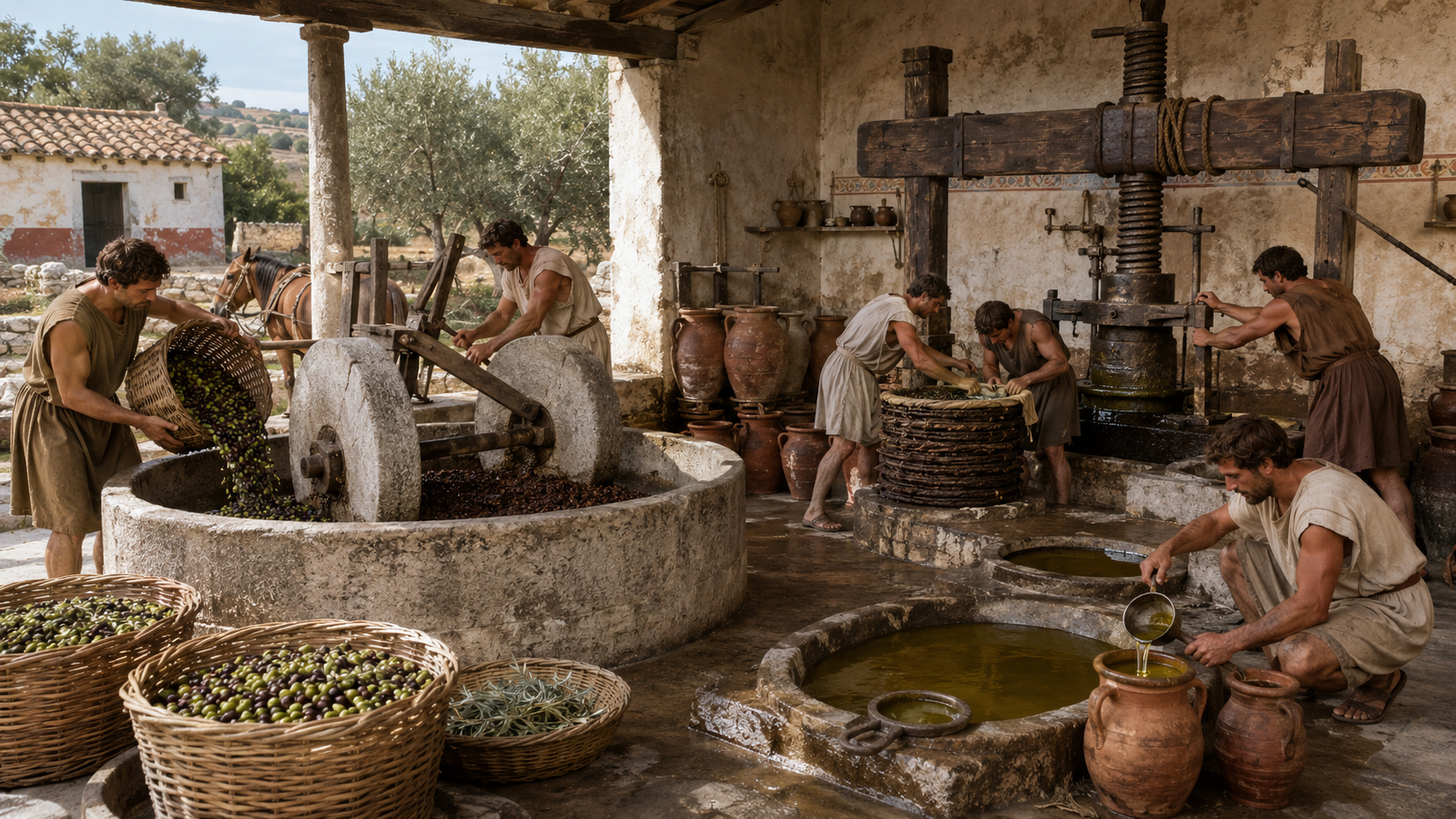
Before dawn on an autumn morning, somewhere on a Roman estate in Campania, Apulia, or the hills beyond Venafrum, the olive harvest began with a kind of urgency that modern people might mistake for romance. It was not romance. It was logistics. The fruit was ripening, storms could knock it to the ground, workers had to be watched, presses had to be ready, baskets had to be mended, jars had to be clean, and every lost hour threatened the flavor of the oil. To a Roman landowner, olive oil was not simply something drizzled over bread. It was food, medicine, lamp fuel, soap before soap, perfume base, gymnasium sheen, religious offering, tax commodity, and export cargo. It moved through kitchens, baths, temples, barracks, markets, and ships.
The Romans did not invent olive oil, but they industrialized it across the Mediterranean. They inherited a technology already old among Greeks, Phoenicians, Etruscans, and peoples of the eastern Mediterranean, then scaled it with the Roman gifts for estate management, engineering, trade routes, and paperwork. By the imperial period, olive oil traveled in huge amphorae from Spain’s Baetica and North Africa to Rome, the Rhine frontier, Britain, and beyond. The Baetican Dressel 20 amphora became one of the most widespread containers in the Roman world, and modern scholars regard it as powerful evidence for the scale of Roman olive oil production and trade.
What follows is both a history and a reconstruction. The steps are drawn from Roman agricultural writers, especially Cato the Elder and Pliny the Elder, then checked against archaeological and modern olive-processing knowledge. A person could reproduce the basic Roman process today, though not with lead vessels, questionable sanitation, or enslaved labor. The olive, luckily, does not require empire to yield its oil. It requires fruit, pressure, patience, and speed.
The Roman Rule: Do Not Let the Olives Wait
Cato the Elder, writing in the second century BCE, is wonderfully unsentimental. In De Agri Cultura, he tells the farm owner to make sure the presses are ready before the olives need them. He warns that if olives stay too long on the ground or on the floor, the oil spoils and becomes rancid. Press them quickly, he says, and the oil will be greener and better.
This is the first great law of Roman olive oil: harvest and press fast.
Cato knew something that modern processors still repeat. Virgin olive oil is fresh fruit juice extracted mechanically. UC Davis describes virgin olive oil as a minimally processed juice made by crushing olives into paste and separating the oil without heat or solvents. Fruit quality, transport, processing, storage, and packaging all determine the final quality.
The Romans did not know the chemistry of oxidation, enzymatic breakdown, or microbial spoilage in the modern scientific sense, but their rules show that they had learned the practical truth. Bruised fruit ferments. Dirty fruit fouls the oil. Delay ruins flavor. The oil must be separated from watery lees and pulp quickly. Cato even tells the ladler to draw off oil twice a day if possible, because the longer it remains with the amurca, the bitter watery residue, and the dregs, the worse it becomes.
Pliny the Elder, writing in the first century CE, agrees in his own more encyclopedic fashion. He says olive-oil making required “more science than making wine,” because the same tree could yield different oils depending on maturity, handling, and processing. He also notes that oil did not improve with age like wine. After a year, he says, oil was already old.
That is the Roman world in miniature: one writer counting ropes, beams, jars, and workers; another surveying nature, flavor, and reputation. Between them lies the smell of crushed olives.
Step 1: Choosing the Olives
A Roman producer did not simply wait until every olive was black and soft. The desired oil determined the harvest.
Pliny says the earliest and finest oil came from raw, unripe olives, with the first issue from the press being richest. But he also says the best compromise between quantity and flavor came when the olive had just begun to turn black.
Cato is more practical. He says the bitterer or more acid olive makes better oil, but the estate owner will profit most by making oil from ripe olives, since mature fruit yields more.
So the Roman producer faced the same problem as the modern grower: early harvest gives sharper, greener, more prestigious oil, but less of it. Later harvest gives more oil, but the flavor becomes heavier and the risk of spoilage rises. The estate owner had to decide whether he wanted glory, profit, household supply, or all three.
For a modern reconstruction, use fresh oil olives, not cured table olives from a jar. The fruit should be recently picked, firm, and clean, with no mold, rot, heavy bruising, or insect damage. If using black ripe olives, remember that UC Davis lists oil content in black olives at roughly 12 to 25 percent depending on cultivar.
Best reconstruction target: olives that are partly green and partly turning purple-black. This gives you something close to the balance Pliny admired.
Step 2: Harvesting Without Ruining the Tree
The Roman harvest could be done by hand, with baskets and nets, or by knocking fruit down with poles or reeds. But Pliny complains that beating the tree injured it and harmed the next year’s crop. He even preserves an old rule: neither strip nor beat the olive tree. Careful growers, he says, used lighter blows with a reed, but even this could damage buds.
This tells us something important. Romans were not careless peasants whacking trees at random. Good olive culture required restraint. The tree was a long investment. Abuse the branches in November, and the following year might punish you.
For a faithful modern method:
- Spread clean cloths, mats, or nets below the tree.
- Hand-pick the best fruit first.
- Use a light rake or flexible rod only if needed.
- Keep ground-fallen olives separate from hand-picked olives.
- Process the best fruit first.
Cato is explicit that windfalls and dirty olives should be gathered quickly, washed if needed, and cleaned of leaves and dung.
For high-quality oil, do not use olives that have been lying on the soil. Romans used them when they had to, but both ancient and modern guidance agree that ground fruit is inferior.
Step 3: Sorting, Cleaning, and Drying
The olives entered the pressing area as a crop, but they had to become a clean working material. Leaves, stems, dust, mud, insects, and animal dung could all ride in with the harvest. Cato tells the producer to wash dirty olives and clean away leaves and dung before milling. He also insists that the pressing room and vessels be kept clean.
This is where we should admire Roman practicality, but also quietly improve on it. Cato recommends certain ancient materials that should not be copied today. He warns against copper vessels because they spoil the flavor, but he also mentions lead vessels, which modern readers should absolutely not use.
For a modern Roman-style batch:
Equipment
- Fresh olives, ideally 10 to 20 pounds for a small trial
- Large food-safe tub
- Clean water
- Towels or drying racks
- Stone mortar, heavy bowl, or food-safe grinder
- Wooden mallet, pestle, or stone roller
- Pressing cloths or fine woven bags
- A strong press, such as a fruit press, wine press, or improvised lever press
- Glass jars or stainless-steel containers
- Ladle or wide spoon
- Fine strainer
- Dark glass bottles
Cleaning process
Rinse the olives in clean water. Remove leaves, twigs, shriveled fruit, moldy fruit, and anything that smells sour. Drain them well. Lay them briefly on clean towels until the surface water is gone. Do not leave them sitting for days. The Roman ideal was urgency. Cato says to mill them a day or two after gathering, and even that was a practical allowance, not an invitation to procrastinate.
Step 4: Crushing the Olives
The Romans did not begin by pressing whole olives. They first crushed them into a paste.
Cato describes the equipment of an olive estate in remarkable detail. A 120-iugera olive yard, if vigorous and well cultivated, should have two pressing setups, stout mills of different sizes, ropes, hand bars, pins, and leather belts. For larger estates, he lists complete pressing equipment, oil jars, vats, baskets, funnels, sponges, ladles, and locks for the oil cellar.
The classic Roman olive mill was often the trapetum, a stone crushing mill designed to break the flesh of the olive without pulverizing the pit too aggressively. Cato’s technical instructions for mounting and adjusting a mill are precise: the central pivot had to stand upright, the stones had to be fixed properly, and the stones had to clear the basin by a small space so they did not grind against the bottom.
This detail matters. Olive oil sits in the flesh of the fruit. Crushing ruptures the cells and frees tiny droplets of oil. But crushing pits too harshly could make the oil taste worse, a point Cato addresses when he warns that seeds should not be crushed for oil because they give a bad flavor.
Modern reconstruction:
- Put cleaned olives into a heavy stone mortar, large bowl, or food-safe crushing tub.
- Crush them until the flesh becomes a coarse paste.
- Do not aim for a smooth purée.
- It is acceptable if pits crack lightly, but avoid pulverizing them into gritty fragments.
- Work in small batches.
A historically inspired method would use a large stone basin and rotating stone wheel. A practical home method is a mortar and pestle, potato masher, meat grinder, or food processor used gently. The food processor is not Roman, of course, but the goal is the same: rupture the fruit, create paste, and avoid overheating it.
Step 5: Resting and Working the Paste
Modern olive oil production uses malaxation, a slow mixing of the paste so tiny oil droplets join into larger droplets. UC Davis lists the typical virgin olive oil processing line as crusher, malaxer, decanter, separator, and oil storage.
The Romans did not use the modern word “malaxation” in the way processors do today, but the physical need was the same. The paste had to be thoroughly worked before pressing. Cato says the olives must be “thoroughly worked up” and that the workers should keep the vessels clean and the olives well dried.
For replication:
- After crushing, stir or knead the olive paste slowly for 20 to 40 minutes.
- Keep it covered as much as possible to reduce exposure to air.
- Do not heat it aggressively.
- If working in a cool room, lukewarm ambient temperature is acceptable, but do not cook the paste.
- The paste should begin to look glossy as oil droplets appear.
Romans sometimes warmed press rooms and storerooms. Cato says to keep a high temperature in the pressing room and storeroom if frost had fallen on the olives. Pliny also notes that fires were lit in presses and cellars because warmth affected oil.
But there is a major caution here. Warmth increases yield, but too much heat damages flavor. A modern reconstruction should keep the paste below hot temperatures. Think warm room, not simmering pot.
Step 6: Loading the Baskets
After crushing, Roman workers placed the olive paste into flexible baskets, mats, or press bags. Cato repeatedly mentions baskets, hampers, and press equipment. He also tells workers to wipe the baskets with a sponge and change vessels daily during oil production.
The principle is simple. Paste must be contained while pressure forces liquid out. The liquid is not pure oil. It is a mixture of oil, vegetation water, and fine solids. The basket or cloth holds back the coarse pulp while the oily liquid runs into a basin.
Modern method:
- Line a press basket with clean pressing cloth.
- Spoon in the olive paste.
- Fold the cloth over the top.
- If using multiple cloth packets, stack them evenly.
- Place a clean board or press plate on top.
Use food-safe cloth, not dyed fabric. Cheesecloth may be too loose unless layered heavily. A sturdy nut-milk bag, cider-press bag, or tightly woven linen works better.
Step 7: Pressing
Here the Roman oil room became a theater of wood, stone, rope, sweat, and command. Cato gives dimensions for a pressing room with four vats facing one another: anchor posts, guide posts, windlasses, press beams, conduits, foundations, smooth pavement, and room for levers. His specified pressing room was not a quaint shed. It was an engineered production space, with beams, foundations, vats, and conduits laid out for repeated heavy work.
Roman presses varied across the empire. Some used lever-and-winch systems. Some used weighted beams. Some later systems used screws. Modern scholarship has moved away from the idea that Roman oil-press technology evolved in one neat line from primitive to advanced. Archaeological evidence shows regional variety, old systems continuing beside new ones, and local communities adapting presses to available stone, wood, and building traditions.
The machines could be enormous. Research summarized by the University of Melbourne notes that ancient wine and oil presses could be up to 12 meters long, 3 to 4 meters high, and weigh many tonnes. They were usually built locally, not transported.
For a small modern reconstruction, you do not need a 12-meter beam. But you do need steady pressure.
Roman-style pressing options
Best practical option: use a small fruit or cider press.
More experimental option: make a lever press. Place the wrapped olive paste under a board. Put one end of a long wooden beam under a fixed support or against a sturdy frame. Let the beam press downward onto the board. Add weight gradually to the free end.
Hydraulic option: use a small hydraulic press with food-safe plates. This gives pressure but is not visually Roman.
Press slowly. Do not smash violently. Increase pressure in stages:
- First light pressure: collect the first liquid.
- Moderate pressure: tighten or add weight.
- Strong pressure: press again after several minutes.
- Optional second working: break up the pressed cake, sprinkle with a little warm water, reload, and press again.
That last step has ancient logic behind it. Pressing wastes, pomace, and warm water were part of ancient production systems, and later evidence shows pomace itself could be reused as fuel. Elizabeth Rowan’s work on olive-oil pressing waste notes that pomace was used as a fuel in antiquity and was tied to the broader economics of oil production.
For the highest-quality edible oil, keep first-press liquid separate from later pressings.
Step 8: Catching the Oil, Water, and Amurca
What runs out of the press is not the golden oil of a grocery-store bottle. It is cloudy, greenish-brown liquid, often sharp-smelling, with oil floating above watery amurca and sediment below. Cato gives one of the most vivid instructions in the whole process: when the workers press down the levers, the ladler must immediately skim off the oil carefully, without taking the amurca. The oil is poured from one vessel to another, each time leaving behind dregs and watery residue.
This is gravity separation. Oil is lighter than water, so it rises. The Romans did with ladles, shells, vats, and patience what modern centrifugal separators do with machinery.
Modern reconstruction:
- Let the pressed liquid sit in a tall glass jar or stainless container.
- Within minutes to hours, the oil will rise.
- The watery layer will sink.
- Sediment will settle at the bottom.
- Skim or siphon the top oil carefully into a clean jar.
- Let it settle again.
- Repeat.
Do not shake the jar. Do not pour aggressively. Every disturbance mixes the layers again.
Cato says to skim frequently and remove lees every day. He wanted the oil moved from vessel to vessel until it reached the final jar, with dregs and amurca left behind.
For a home batch, rack the oil at least twice:
- First separation: after 2 to 6 hours.
- Second separation: after 24 hours.
- Third settling: after several days.
- Longer settling: 30 to 45 days if you want clearer oil, though modern best practice would use filtration or controlled storage.
UC Davis notes that modern high-quality storage involves stainless tanks, temperature control, limiting oxidation, filtering or regularly draining water and sediment, and keeping oil around 59 to 64°F.
Step 9: Storing the Oil
Roman oil was stored in jars, vats, and amphorae. Cato gives instructions for preparing new oil jars by filling them with amurca for seven days, drying them, warming them, and rubbing in gum.
That jar-preparation method belongs to an ancient ceramic world. A porous clay vessel could absorb oil, leak, or spoil flavor if not treated. The Romans had to season and seal their containers.
For modern use:
- Store oil in dark glass bottles or stainless steel.
- Keep it cool, ideally around cellar temperature.
- Keep it away from light and air.
- Leave sediment behind.
- Use it relatively quickly.
Pliny is blunt that olive oil does not improve with age. It becomes old after a year.
This is one of the great differences between wine and oil. Wine might be laid down with hope. Oil was a race against decline.
Step 10: Using the Leftovers
A Roman estate wasted less than we do. The remaining pressed cake, called pomace, could be used as fuel, animal feed in some contexts, or further processed for inferior oil. The watery residue, amurca, was bitter and unpleasant, but not useless.
Pliny records Cato’s praise of olive lees. It could be used to treat vats and casks, floors, storage spaces, leather, axles, copper vessels, and wood.
This is not a recommendation to pour olive wastewater around your house. Ancient amurca is chemically harsh and environmentally problematic in quantity. But historically, it shows how tightly integrated Roman agriculture was. The estate was a system. Oil, lees, pomace, baskets, amphorae, animals, fuel, fields, and markets all belonged to one chain.
A Replicable Roman-Style Olive Oil Process
Here is the whole method in practical form.
Ingredients
- 10 pounds fresh oil olives, ideally partly green and partly turning purple-black
- Clean water for rinsing
- Optional: a small amount of warm water for a second pressing, not for the first high-quality pressing
Equipment
- Food-safe tub
- Towels
- Heavy mortar and pestle, stone grinder, or gentle food processor
- Large bowl for kneading paste
- Pressing cloths or food-safe woven bags
- Fruit press, cider press, or lever press
- Tall glass jars
- Ladle or siphon
- Fine mesh strainer
- Dark glass bottles
Day 1: Harvest and Clean
Pick the olives by hand or with gentle raking. Keep fallen fruit separate. Wash only if dirty, then dry the fruit. Remove leaves, twigs, bad olives, and debris. Work as soon as possible.
Day 1: Crush
Crush the olives into coarse paste. Avoid pulverizing pits into grit. The paste should be wet, chunky, and glossy.
Day 1: Work the Paste
Stir and knead slowly for 20 to 40 minutes. Keep the paste covered. Do not cook it.
Day 1: Load the Press
Spoon paste into cloths. Fold tightly. Stack evenly in press basket or between boards.
Day 1: Press
Apply pressure gradually. Collect the liquid in a clean vessel. Keep the first pressing separate.
Day 1: Optional Second Pressing
Break up the pressed cake. Add a little warm water. Mix, reload, and press again. This gives more liquid but lower-quality oil. Keep it separate from the first pressing.
Day 1 to Day 2: Separate
Pour the pressed liquid into a tall jar. Let it settle. Skim the oil from the top carefully. Transfer into another clean jar. Leave watery amurca and sediment behind.
Days 2 to 7: Rack Again
Let the oil settle again. Transfer the clearer top oil into another jar or bottle. Repeat if needed.
Storage
Bottle in dark glass. Keep cool, closed, and away from light. Use within a few months for best flavor.
What Would It Taste Like?
A good Roman-style oil made from fresh, early olives would probably be cloudy at first, greenish, grassy, peppery, and bitter. If made from riper olives, it would be softer, more golden, and likely less pungent. If delayed, dirty, or poorly separated, it could turn muddy, sour, rancid, or harsh.
The Romans understood this with a directness that should embarrass us a little. They did not need a modern tasting panel to know that laziness had a flavor.
The People Behind the Oil
It is tempting to imagine olive oil as a pastoral craft, and sometimes it was. But Roman estate production also rested on hard labor, much of it enslaved. Cato’s farm manual discusses overseers, laborers, chained workers, rations, tools, watchmen, and locked oil cellars. He treats the estate as a machine of production, with people folded into the inventory beside ropes, jars, oxen, presses, and baskets.
That reality belongs in the story. Olive oil helped make Roman life comfortable, but comfort in Rome often rested on coercion. The golden liquid in the lamp had a human shadow.
Still, the work itself was skilled. The mill had to be adjusted. The press had to be assembled. The paste had to be judged. The oil had to be skimmed without taking the amurca. The jars had to be prepared. The timing had to be right. A careless worker could ruin a batch; an experienced one could save it.
Why Roman Olive Oil Mattered
By the high empire, olive oil had become one of the great arteries of Roman civilization. It fed bodies, lit rooms, cleaned skin, marked status, scented rituals, and supplied armies. Rome’s appetite was so vast that provinces specialized in feeding it. Southern Spain’s Guadalquivir valley became one of the great engines of oil production, supported by olive agriculture, ceramic workshops, river transport, and amphora distribution.
The making of oil was therefore not a rustic footnote. It was agriculture, engineering, chemistry, commerce, administration, and empire pressed into one substance. Every amphora of oil arriving in Rome carried with it a landscape: trees on a hillside, workers in a press room, potters by a river, merchants tallying weights, sailors loading cargo, officials checking marks, cooks pouring oil into pans, bathers scraping it from their skin.
And at the beginning of all of it was the olive itself, stubborn, bitter, silver-leaved, and generous only when handled with discipline.
The Romans would have understood the lesson. You cannot bully good oil out of bad fruit. You cannot wait too long and expect freshness. You cannot ignore the vessel, the room, the worker, the weather, the beam, the basket, or the dregs. Olive oil was made in the narrow passage between abundance and decay. The fruit was picked, crushed, pressed, skimmed, settled, sealed, and hurried into use before time could spoil it.
That is how Romans made olive oil: with stone, wood, rope, heat, labor, and watchfulness. Not delicately, exactly. Not primitively either. They made it with the seriousness of people who knew that civilization itself sometimes depends on getting the harvest in before the storm.