
When we think of Pompeii, we often think of ruins.
Stone streets. Empty houses. Frescoed walls. Bodies preserved in ash. A city frozen in time.
But Pompeii was not always silent.
Before the eruption of Mount Vesuvius in 79 AD, Pompeii was a living Roman city. Its streets were filled with merchants, bakers, enslaved workers, freedmen, children, travelers, craftsmen, politicians, and families going about the ordinary business of life. Bread was baked. Meals were served. Prayers were offered at household shrines. People argued over money, gossiped in the street, visited food stalls, worked in shops, and looked toward the future.
Then, in a matter of hours, the world they knew disappeared.
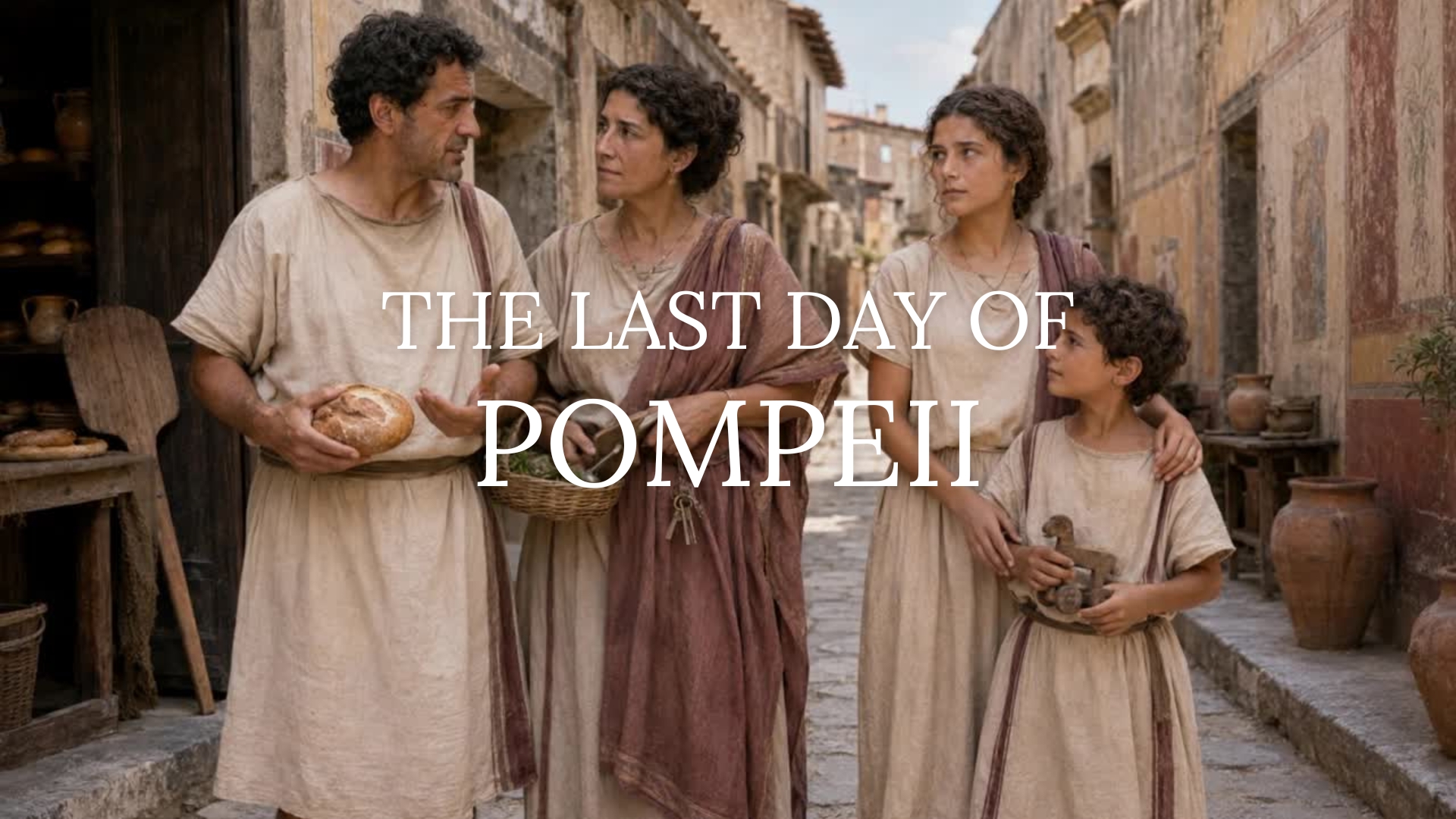
Our new short docu-drama, Pompeii: The Last Day, uses AI-generated cinematic imagery to tell the story of one fictional but historically plausible family living through the final hours of the city. It is not a story about emperors, generals, or senators. It is a story about ordinary people caught inside one of history’s most unforgettable disasters.
A Family at the Heart of History
At the center of the film is a Pompeian household: Lucius, Aelia, Marcia, Titus, and Dama.
Lucius is a middle-class baker or tavern keeper, practical, proud, and deeply attached to the city he believes will endure. Aelia, his wife, manages the household, food, finances, and religious rituals. She senses danger earlier than Lucius, but like many people facing catastrophe, the family first tries to make sense of the strange signs through the lens of normal life.
Their daughter Marcia is intelligent and restless, curious about the world beyond Pompeii. Their young son Titus sees the falling ash and pumice first with wonder, almost like snow, before fear takes over. Dama, an enslaved household worker or freedman assistant, reminds us that Roman households were complex social worlds, shaped by affection, labor, dependency, and inequality.
Together, they allow us to see Pompeii not as a ruin, but as a place of relationships.
From Daily Life to Disaster
The film begins quietly.
The sun rises over Pompeii. Lucius checks bread in the oven. Aelia lights incense at the household shrine and speaks to the Lares, the protective spirits of the home. Marcia complains about chores. Titus plays with a small toy. Dama opens the shutters.
Outside, the city breathes. People walk along raised sidewalks. Carts move through the streets. Food stalls serve customers. Workshops open. Election graffiti marks the walls. A fountain runs nearby. Mount Vesuvius stands in the distance, visible but ignored.
That is one of the most powerful ideas behind the film: disaster often begins inside the ordinary.
At first, the warning signs are easy to dismiss. A tremor shakes the household. Dishes fall. People laugh it off. Vesuvius smokes in the distance, but Lucius remains calm. The city has survived earthquakes before. Why should this day be different?
But then the sky begins to change.
Sunlight disappears. Smoke thickens the air. Ash starts to fall. Pumice rains down into the streets. The familiar city becomes strange, dark, and dangerous. The family’s home, once a place of safety, becomes a place of uncertainty.
Why Tell the Story This Way?
Pompeii is often treated as a spectacle of destruction. But the real power of Pompeii is not just that a city was buried. It is that the people of that city were interrupted mid-life.
They did not know they were becoming history.
They were not symbols. They were not archaeological evidence. They were human beings with routines, fears, hopes, obligations, and people they loved.
That is why Pompeii: The Last Day focuses on one household rather than the entire city. A disaster becomes more meaningful when we experience it through individual lives. The eruption of Vesuvius was enormous, but the tragedy was intimate. A mother protecting her child. A father reaching for his daughter’s hand. A family trying to decide whether to shelter or flee. A household worker whose life was bound to the family by duty and circumstance.
These moments bring the ancient world closer.
A Docu-Drama Built with AI
This project also explores a new frontier in historical storytelling: using AI-generated visuals to reconstruct the past in an emotionally compelling way.
The goal is not to replace scholarship or archaeology. The goal is to use new tools to make history feel immediate, visual, and human.
Every image was designed with attention to historical atmosphere: Roman clothing, domestic interiors, household shrines, Pompeian streets, food counters, painted walls, carts, sidewalks, stepping stones, ashfall, smoke, and the terrifying darkness that would have overtaken the city.
The result is a short film that feels less like a lecture and more like stepping into a historical memory.
The Human Meaning of Pompeii
Nearly two thousand years later, Pompeii still haunts us because it preserves something rare: the ordinary lives of people who had no idea their final day would be studied for centuries.
Their city was not frozen in time. It was interrupted.
That distinction matters.
Pompeii reminds us that history is not only made by the powerful. It is also made by families in kitchens, children in courtyards, workers in shops, and neighbors passing one another in the street. It is made in the small details of daily life, and sometimes, it is preserved because disaster stops those lives in place.
Pompeii: The Last Day invites viewers to look beyond the ruins and imagine the people who once lived there.
Before the ash, there was a city.
Before the casts, there were bodies.
Before the tragedy, there was a family.