
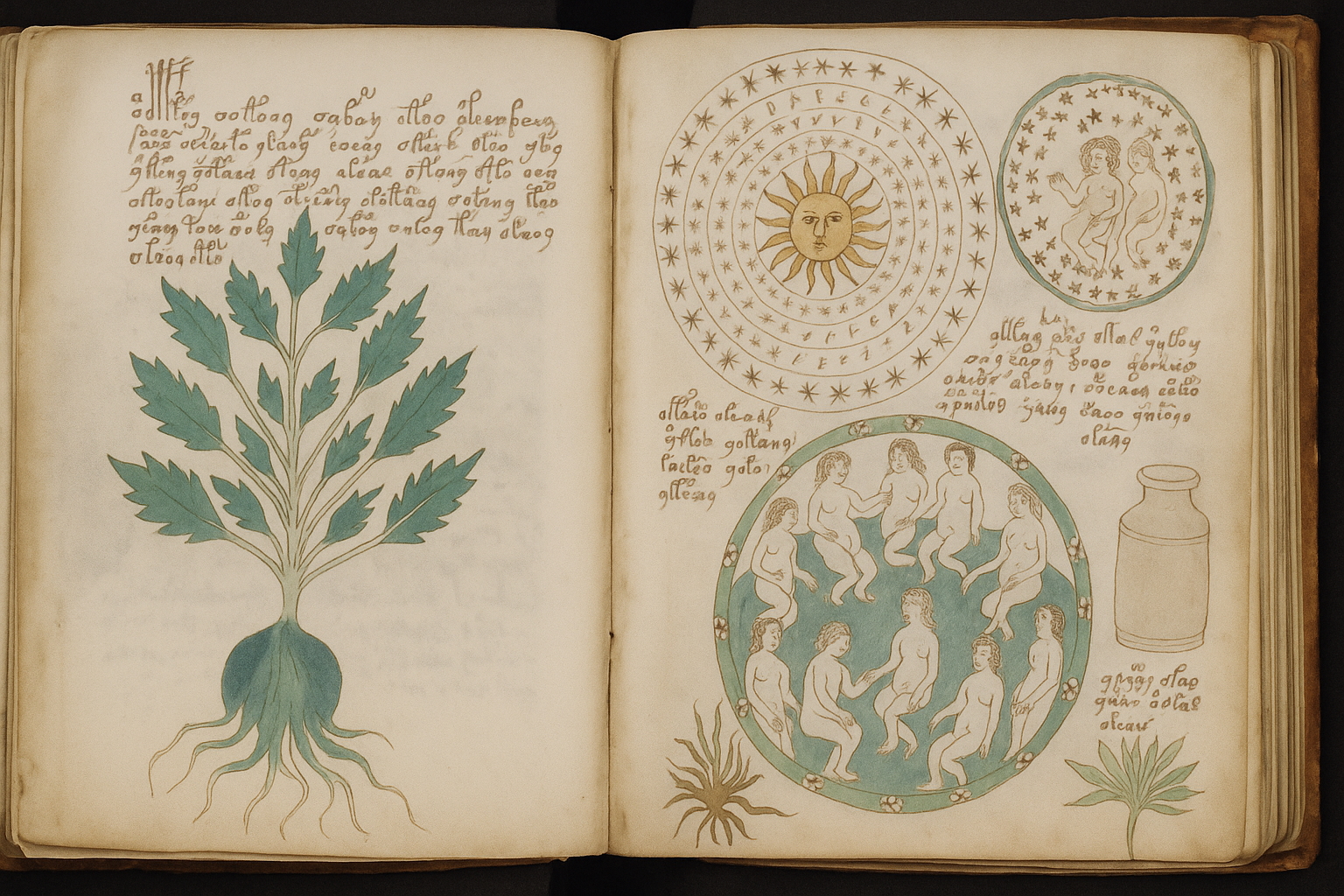
In a quiet library at Yale University lies a book that has baffled some of the world’s sharpest minds for more than a century. Bound in vellum, filled with strange illustrations, and written in an unknown script, it has become a riddle wrapped in parchment: the Voynich Manuscript.
Scholars, cryptographers, linguists, and conspiracy theorists have all tried their hand at deciphering its secrets. Some believe it hides lost medieval knowledge; others insist it’s nothing more than an elaborate hoax. But one thing is certain: no one has ever truly cracked it.
A Curious Discovery
The story begins in 1912, when Wilfrid Voynich, a Polish rare book dealer, purchased a collection of old manuscripts from a Jesuit college near Rome. Among them was a strange codex of about 240 pages, covered with looping, ornate script in a language no one recognized.
Voynich, well-versed in rare books, knew immediately he had stumbled upon something extraordinary. But extraordinary doesn’t mean understandable. The text seemed to follow rules, repeated words, consistent grammar-like patterns, but not in any known language.
When Voynich revealed his find to the academic world, it sparked both fascination and frustration. Here was a book no one could read, accompanied by bizarre illustrations:
- Botanical drawings of plants that didn’t exist in any herbarium
- Astronomical diagrams with suns, moons, and stars in strange configurations
- Human figures, often women, bathing in interconnected pools of water
- Pharmaceutical sketches of jars and tubes
The manuscript seemed like a medical or scientific treatise, but of what kind, and by whom?
A Manuscript Out of Time
Dating the book was the first step toward solving its mystery. In 2009, researchers at the University of Arizona used radiocarbon analysis on the vellum (calfskin parchment) and determined it was made between 1404 and 1438. This places the manuscript squarely in the European Middle Ages, at the dawn of the Renaissance.
So, if it’s authentic to that period, who wrote it? Theories have flown for decades:
- Roger Bacon, the 13th-century English philosopher, was once suspected. Voynich himself believed this and hoped the book would make his name. But carbon dating proved the parchment too young.
- Leonardo da Vinci has also been suggested, though his lifetime (1452–1519) is slightly later than the manuscript’s creation.
- Some argue it was the work of an unknown medieval alchemist or herbalist, recording secret knowledge in a cipher to keep rivals at bay.
- Others insist it could be an elaborate hoax, created simply to fool wealthy patrons into believing they were buying hidden wisdom.
The Codebreakers’ Challenge
During World War II, some of the greatest minds in codebreaking were enlisted to try their hand at the Voynich Manuscript. These were the same men who cracked Nazi ciphers. Yet despite their brilliance, the Voynich resisted all attempts at decryption.
Part of the frustration is that the script, often called “Voynichese”, is consistent and rule-bound, unlike gibberish. Words repeat, sentence structures follow patterns, and it even obeys the statistical laws of language (like Zipf’s law, which predicts word frequency). This makes many experts believe it really is a language or at least a constructed one.
But no known alphabet matches it. No bilingual “Rosetta Stone” exists to guide us.
What Do the Pictures Mean?
If the text cannot be read, perhaps the pictures offer clues. The manuscript is divided into sections that appear to represent:
- Botany: Pages of unknown plants, many resembling composites of real species.
- Astronomy: Diagrams with zodiac symbols, star charts, and possibly calendars.
- Biology: Dozens of naked women, often interacting with flowing tubes of water.
- Medicine: Drawings of jars, roots, and recipes.
Taken together, these suggest the manuscript might have been an herbal or medical compendium, perhaps intended for women’s health or alchemy. Yet the strangeness of the drawings, the invented plants, the bizarre plumbing-like tubes, makes interpretation perilous.
The Theories
Over the last century, the Voynich has inspired more speculation than perhaps any other manuscript:
- A Lost Language: Some scholars think it could be a forgotten dialect, perhaps from medieval Central Europe or Asia.
- An Invented Language: Others suggest it may be a constructed language, created to encode knowledge or simply for intellectual play.
- A Cipher: Code enthusiasts argue the text hides encrypted Latin or another known language, though no cipher has ever fit.
- A Hoax: A growing camp believes it was nonsense from the beginning, made to look scholarly and sold for profit. The problem? Creating such elaborate “nonsense” with consistency would have been an immense effort in itself.
Why It Matters
Why obsess over a book that refuses to reveal its meaning? The allure of the Voynich Manuscript lies not just in what it says (or doesn’t say), but in what it represents: the limits of human knowledge.
Here we are, in the 21st century, with artificial intelligence, space telescopes, and quantum computing. Yet, a 600-year-old book still laughs at us from the shelves of Yale’s Beinecke Rare Book & Manuscript Library.
The Voynich reminds us that history still keeps secrets, that there are puzzles time has not yet solved.
The Final Word, Or Lack of One
Today, the Voynich Manuscript is available online, digitized for anyone to pore over. Amateur sleuths and professional scholars alike continue to examine it. Every year, someone claims to have cracked its code. Every year, the claims fall apart under scrutiny.
Perhaps one day the secret will be revealed, unlocking the thoughts of a long-dead author. Or possibly its mystery is the point that it was always meant to intrigue, to confound, to seduce us into chasing meaning where none exists.
Until then, the Voynich Manuscript remains what it has always been: a riddle with pages. A book of secrets that may never whisper its truth.