
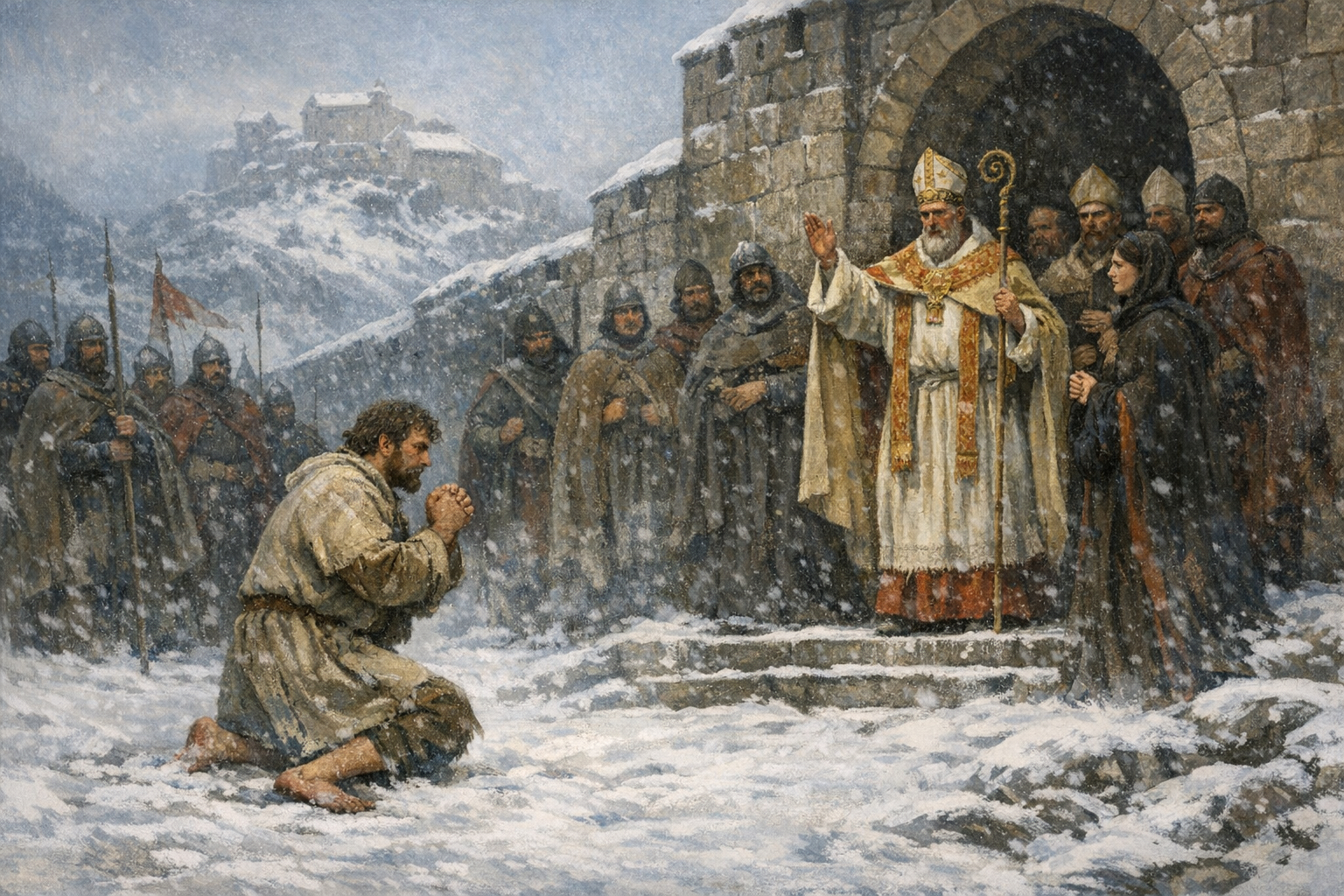
In the last week of January 1077, a king who had been raised to see himself as God’s anointed ruler of the Germans came to a mountain fortress in the northern Apennines and asked, publicly and insistently, to be let back into the Church. His name was Henry IV. The man inside the walls was Pope Gregory VII. Between them lay an argument that was not about manners, or pride, or even personal dislike, but about who had the right to shape Christian society: the crown or the papacy. The episode has survived in Western memory as the “Walk to Canossa,” a phrase that still means humiliation. But in its own time, it was something sharper and more strategic: a staged act of penance meant to change political reality.
A crisis of legitimacy, not just a quarrel of egos
By 1076, Henry’s position had become dangerously unstable. Gregory had excommunicated him, and in an age when kings ruled through oaths, sacral authority, and the consent of powerful men, excommunication was not merely “bad press.” It threatened the glue holding Henry’s rule together by signaling to Christian elites that their sworn loyalty could be morally and spiritually compromised.
Gregory’s own correspondence makes clear that the conflict was not treated as a private matter between two proud leaders. It was addressed to the princes and bishops of the German kingdom as a public problem that demanded public remedies, with “peace of the church” and “concord of the kingdom” as the stated stakes.
The scene at the gates: what we can say with confidence
The famous details vary across medieval narratives, and modern scholarship is careful about how literally to take every flourish. Still, one core fact is exceptionally well supported: there was a reconciliation at Canossa in late January 1077, and Gregory lifted Henry’s excommunication under conditions.
We have Gregory’s own account in a letter written “at Canossa” to German churchmen and princes. In it, Gregory reports that Henry arrived at the castle gate “barefoot and clad only in wretched woollen garments,” begging for absolution, and that he persisted for three days until those around the pope pressed him to relent. Gregory even admits that observers criticized his delay, accusing him of something closer to tyranny than pastoral discipline. Then, Gregory writes, he removed the ban and received Henry again into the Church.
That letter is precious not only for what it says, but for how it says it. It is a papal explanation aimed at an audience with power. Gregory is defending his choice to absolve a king who had openly challenged him. The tone is managerial and political, not dreamy and mystical. This was reconciliation as statecraft.
The oath: the hidden machinery inside the drama
The reconciliation was not a warm embrace and a clean slate. It came with an oath, preserved alongside the Canossa correspondence, in which Henry promised to resolve grievances raised by German bishops, dukes, counts, and princes within a set time, “according to [the pope’s] judgment” or by peace on the pope’s counsel. Henry also pledged safe conduct for Gregory’s travel, a crucial point given the volatility of northern Italian and German politics.
This is where the romance of the snow scene meets the paperwork of power. The oath shows what the ritual was trying to accomplish: to keep the political process (and the pope’s role in it) intact, while removing the spiritual poison of excommunication that threatened to dissolve Henry’s authority altogether.
Who brokered mercy: the people history used to sideline
Canossa was not only Henry and Gregory. It took place in a castle associated with Matilda of Tuscany, and contemporaries repeatedly emphasized mediation by figures around the principals. Modern research has been especially illuminating on the role of elite women in these negotiations, reminding us that “high politics” in the eleventh century was often family politics, alliance politics, and intercession politics.
A peer-reviewed study by Alison Creber argues that sources close to the event portray women, including Matilda of Tuscany and Adelaide of Turin, as central intermediaries in the reconciliation, and that their presence is not incidental but structurally important to how agreement was reached. This fits the broader reality of aristocratic mediation in an age when formal institutions were fewer and relationships did much of the governing.
Even Gregory’s own account places named guarantors around Henry’s oath, including the abbot of Cluny and Matilda, underscoring that this was a negotiated settlement secured by reputations and networks, not a solitary spiritual breakthrough.
Was it humiliation or a masterstroke?
If you freeze the story at the moment of bare feet in winter, the answer seems obvious: humiliation. But if you widen the frame, Henry’s journey reads less like surrender and more like a maneuver to regain freedom of action.
Gregory indicates that Henry approached Canossa while broader arrangements were in flux, including questions about escort and counsel among German elites. The absolution restored Henry to communion, and that mattered because it blunted the moral argument for abandoning him. It did not end the political struggle. It shifted the terrain on which the struggle would continue.
Modern scholarship tends to treat Canossa as a public act with public consequences, not as a private spiritual scene accidentally witnessed by history. A Cambridge University Press chapter on Canossa stresses both the ritual’s symbolic weight and the fact that its immediate resonance was more complicated than later legend suggests, growing over time as Canossa became a cultural shorthand for the balance between secular and ecclesiastical authority.
Why Canossa still matters
Canossa is a small word that became a large argument. It raises a question that does not age out: what happens when political legitimacy depends on moral authority that lies outside the state? In 1077, the answer was enacted through ritual, oath, witness, and the harsh clarity of winter weather.
The irony is that Canossa endures not because it solved the Investiture conflict, but because it revealed its essence. Kings needed sacral credibility. Popes needed political leverage. Both claimed to stand for order in a Christian world, and both understood that symbols could govern real behavior.
That is why the scene remains unforgettable, even when we strip away the legend’s extra snowdrifts. A ruler’s bare feet at a fortress gate were not just an image of abasement. They were an attempt to force history’s hand.