
On a warm Sunday morning, June 28, 1914, a motorcade rolled through Sarajevo, capital of Austria-Hungary’s restless province of Bosnia. The Archduke Franz Ferdinand, heir to the Habsburg throne, sat exposed in an open car. By the end of the hour, he and his wife Sophie were dead, shot at close range by Gavrilo Princip, a Bosnian Serb tied to a militant nationalist underground. It was an assassination, yes, but it was also something rarer and far more dangerous: a political shock that struck every fragile seam in Europe’s great-power system at once.
To understand what World War I was “about,” you have to picture Europe in 1914 not as a calm chessboard but as a crowded room full of men with loaded pistols, each convinced someone else was reaching first. Great empires sat on top of nationalist pressures (especially in the Balkans), while military plans and railroad timetables promised speed and punished hesitation. Diplomacy existed, but it ran alongside a growing belief that the next war might be short, cleansing, even manageable. In hindsight, that confidence reads like a tragic misprint in the margins of history.
What the war was, in plain terms
World War I (1914–1918) began as a European conflict and became a global one. The core fight pitted the Central Powers (Germany and Austria-Hungary, later joined by the Ottoman Empire and Bulgaria) against the Allied powers (France, Russia, and Britain at the start, later joined by Italy, the United States, and many others). It spread across continents through empires, colonies, sea lanes, and resource demands, then ground itself into something even more defining than a map of fronts: an industrialized struggle of mass armies, artillery, machine guns, submarines, and eventually tanks and aircraft.
If earlier European wars could be brutal, this one was systemic. It aimed not just to defeat armies but to exhaust societies.
Why it happened (and why “one cause” is the wrong question)
The Sarajevo assassination was the spark, but the tinder had been drying for years. Historians generally point to several overlapping forces:
Nationalism, particularly in multiethnic empires like Austria-Hungary, where Slavic nationalism challenged imperial rule in the Balkans.
Alliance politics, which were meant to deter war but often made crises harder to localize. Once mobilizations began, commitments and fears pulled more states in.
Militarism and planning, where war plans and mobilization schedules created pressure to act quickly, shrinking the space for negotiation during a fast-moving crisis.
Imperial competition and insecurity, the long, grinding contest for status, markets, and strategic advantage among the major powers.
There is also a crucial point about agency. The war did not “just happen.” Governments made decisions, often under pressure, often with imperfect information, but still decisions. That is why the origins remain debated: not because the facts are unknowable, but because responsibility can be distributed in different ways depending on how you weigh choices made in Vienna, Berlin, St. Petersburg, Paris, London, and Belgrade.
So who started what?
Here is the cleanest way to describe the chain of escalation, without pretending it was inevitable:
- Austria-Hungary decided to punish Serbia, believing Serbian nationalism threatened the empire’s survival after the assassination.
- Austria-Hungary declared war on Serbia on July 28, 1914.
- Russia moved to support Serbia (and to maintain influence in the Balkans), escalating the conflict.
- Germany, Austria-Hungary’s key ally, supported Vienna and took steps that helped turn a Balkan war into a broader one.
- France, allied to Russia, and Britain, tied by strategic commitments and alarmed by German actions, entered as the crisis widened.
By early August, Europe’s crisis machinery had become a war machine.
What made the fighting so catastrophic
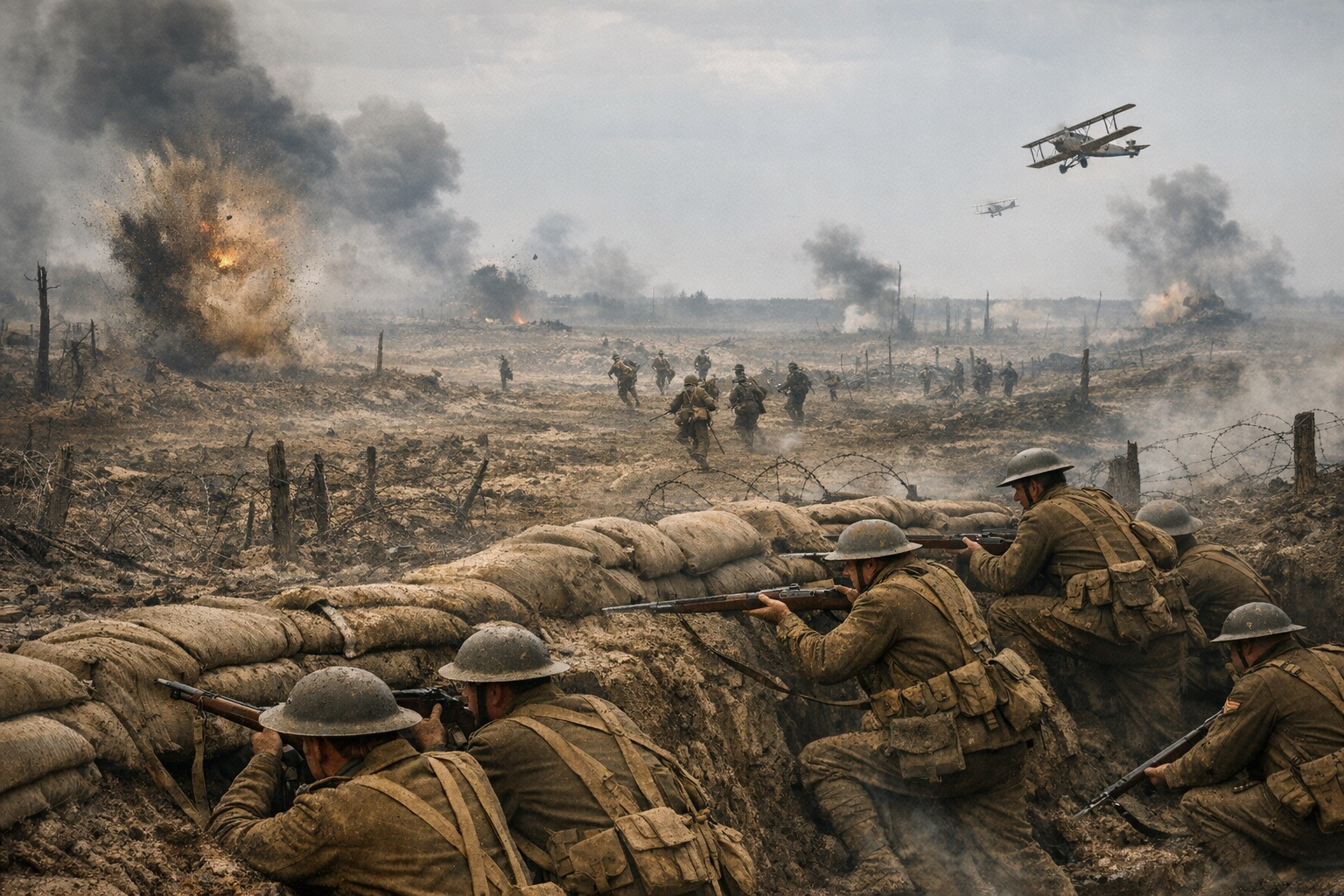
Much of the popular memory centers on the Western Front, where trenches became both shelter and prison. The stalemate was not just “two sides stuck.” It was the collision of defensive firepower (machine guns and massed artillery) with offensive doctrine that had not yet adapted. Attacks could gain yards at enormous cost.
Artillery dominated. It shredded bodies, landscapes, and morale. Entire villages vanished into mud and chalk dust. And the war did not stay on one line of trenches. It unfolded on the Eastern Front, in the Balkans, in Italy, across the Middle East, on the seas, and throughout the colonial world.
A few “interesting facts” that actually matter
The war’s death toll was staggering: estimates commonly run to about 16 million dead (soldiers and civilians) with many more wounded and displaced. Exact totals vary by method, but the scale is not in dispute.
The peace settlement, especially the Treaty of Versailles (1919), did more than redraw borders. It also included clauses that assigned Germany and its allies responsibility for losses and damages, a foundation for reparations and a lasting source of political bitterness. (One famous provision is Article 231, often called the “war guilt” clause.)
The war accelerated the collapse of old imperial orders. By the early 1920s, the German, Austro-Hungarian, Ottoman, and Russian empires had broken apart or been fundamentally transformed, leaving new states, new minorities, and new disputes behind.
Why it still casts a shadow
World War I rearranged the world’s political geography, but its deeper legacy was psychological and institutional. It taught modern states how to mobilize entire societies for war, how propaganda and rationing could be national policy, how civilian suffering could be strategic rather than incidental. And it left behind unresolved questions, resentments, and border dilemmas that would not stay quiet.
If the nineteenth century ended in Sarajevo, the twentieth began in the trenches.