
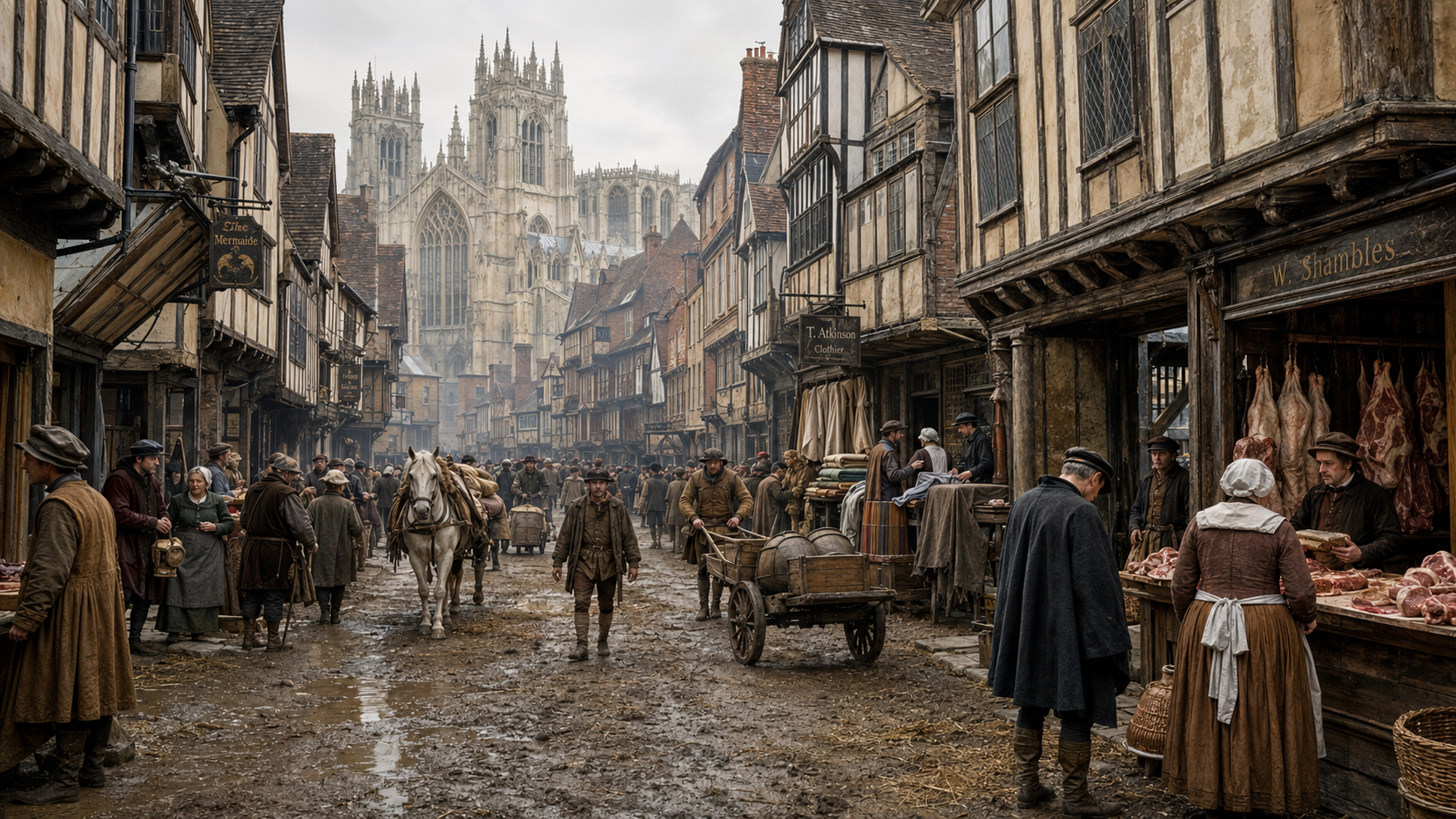
To enter York in 1553 was to step into a city suspended between two ages.
Its skyline, streets, walls, markets, churches, and houses remained overwhelmingly medieval. York Minster towered above a crowded landscape of steep roofs, chimneys, parish churches, fortified gates, timber-framed houses, gardens, workshops, and religious buildings. Yet the institutions that had created this city were being dismantled or transformed by the English Reformation.
Monasteries had been dissolved. Shrines had been destroyed. Parish churches had been stripped of altars and images. Then, in the summer of 1553, the death of the Protestant king Edward VI and the accession of the Catholic Mary I began another dramatic religious reversal.
For the people living inside York’s walls, these were not distant political events. They altered the appearance of their churches, the rhythms of worship, the ownership of land, the use of former religious buildings, and the language through which people understood life, death, salvation, and community.
What would York have looked and felt like during this extraordinary year?
A Medieval City Beneath the Minster
Approaching York across the flat Vale of York, a traveler would first have noticed its skyline.
York Minster dominated everything. Its massive central tower and twin western towers rose far above the city’s houses and parish churches. By 1553, the Minster had reached essentially its completed medieval form, with soaring Gothic windows, pinnacles, buttresses, battlements, carved stonework, and an immense collection of stained glass. The University of York describes the Minster as preserving Britain’s most extensive collection of medieval stained glass, dating from the late 12th through the early 16th century.
Below it stood a dense but uneven city enclosed by medieval fortifications. The major entrances were monumental gatehouses known as bars: Micklegate Bar, Bootham Bar, Monk Bar, and Walmgate Bar. These were not decorative arches. They were defensible structures with heavy doors, chambers, narrow passages, and spaces used by guards, officials, and gatekeepers. The walls and gates established a sharp division between the city and the gardens, fields, roads, orchards, and scattered buildings outside.
The York of Henry VIII’s accession had been described by historians as a city of “picturesque and pinnacled splendour,” filled with religious houses, almshouses, guild buildings, parish churches, gates, towers, and substantial private residences. Much of that physical city still stood in 1553, even though many of its institutions had disappeared.
York remained one of the most important cities in northern England, but it was considerably smaller and poorer than it had been at the height of the Middle Ages. Estimates suggest that the population had fallen to approximately 7,000 in the 1520s and had probably recovered to around 8,000 by the 1540s. That was enough to create busy central streets, but the city’s large enclosed area also contained gardens, orchards, vacant properties, former religious precincts, and districts showing clear signs of economic decline.
Passing Through the Gates
A royal visitor approaching from the south would traditionally enter through Micklegate Bar.
The experience would have been deliberately impressive. The traveler passed beneath a stone arch and the rooms constructed above it, leaving the relative openness of the countryside for a compressed urban environment of houses, inns, workshops, churches, carts, animals, and pedestrians.
From Micklegate, the road descended toward the River Ouse. The streets did not follow a modern grid. They inherited centuries of Roman, Scandinavian, Anglo-Saxon, and medieval development, producing an irregular network of bending thoroughfares and narrow passages.
Micklegate, Coney Street, Stonegate, Petergate, Goodramgate, Walmgate, Fossgate, Coppergate, Pavement, and the Shambles were already old streets by 1553. Many were narrow enough that carts, packhorses, pedestrians, market stalls, and shop counters competed for the same limited space.
Crossing the Ouse was itself a memorable experience. The medieval Ouse Bridge was not an open bridge offering uninterrupted river views. Buildings and chambers stood on or immediately beside it, and part of the structure was used as a prison during the 16th century. It functioned as an inhabited urban street stretched across the water.
Below, boats carried grain, timber, fuel, food, raw materials, and merchandise. York’s position on the River Ouse had long connected it to regional and wider commercial networks, even as its role in long-distance trade weakened during the later Middle Ages and Tudor period.
Streets of Timber, Plaster, Brick, and Stone
Modern visitors often imagine Tudor streets as rows of perfectly maintained black-and-white houses. York in 1553 would have been more irregular and less visually uniform.
The Royal Commission’s architectural survey concluded that the central area of York had once consisted almost entirely of timber-framed houses. Many were built on long, narrow plots, with a relatively small street frontage and buildings, workshops, yards, sheds, kitchens, privies, and gardens extending behind them.
Some houses rose three storeys and projected over the street through jettied upper floors. Heavy oak posts supported walls filled with plaster or other materials. The timber might appear brown, grey, smoke-darkened, tarred, painted, or partly covered by limewash. Plaster panels could be cream, pale grey, ochre, yellowish, or dirty white.
Surviving structures in the Shambles demonstrate the presence of substantial timber-framed houses dating from the 14th through the 17th centuries. The Royal Commission records 15th-century buildings of three storeys in this part of York, providing valuable evidence for the type of architecture that remained visible in 1553.
Ground floors frequently opened directly onto the street. Wooden shutters could be lowered or raised to create counters where merchants displayed cloth, food, leather goods, metalwork, or household objects. Signs might hang above the entrance, particularly because literacy was far from universal.
Windows were small by modern standards. Wealthier houses might possess leaded glass made from many small panes, but glass remained a significant possession. Interiors were darker than modern reconstructions often suggest, especially in houses crowded between neighboring structures.
Behind the better street fronts, conditions varied sharply. A merchant’s house could contain painted cloths, carved furniture, metal vessels, books, glassware, and imported goods. A laborer or poor artisan might possess only a few pieces of basic furniture, cooking equipment, bedding, clothing, and work tools. Archaeological and probate research into York households reveals substantial differences in material comfort and consumption across the urban population.
The Markets of York
York was a city of markets as much as churches.
Pavement, Thursday Market, Coney Street, the Shambles, and other commercial spaces filled with traders, animals, carts, baskets, barrels, stalls, and customers. These markets were not large, formally planned plazas. They were widened portions of an already congested street system.
The city corporation regulated where and when goods could be sold. York’s documented markets included the sale of grain, wool, malt, livestock, meat, fish, foodstuffs, and manufactured goods. The malt market in Coney Street operated on specified days, with its opening announced by a bell. Market rights, tolls, and locations formed part of the city’s carefully controlled civic economy.
On a market morning, country people would enter through the bars carrying produce from the surrounding region. Butter, eggs, poultry, vegetables, grain, hides, wool, animals, and fuel arrived alongside manufactured goods and imported merchandise.
Merchants and craftsmen opened their shutters. Apprentices moved merchandise, swept work areas, carried messages, and guarded stalls. Porters transported bundles and barrels. Servants negotiated purchases for wealthier households. Civic officials watched for unlawful trading, incorrect weights, obstruction, and breaches of market regulations.
The Shambles was closely associated with butchers. Meat could be cut and displayed at open-fronted shops, with work performed close to the street. Archaeological evidence from York records carcass preparation, food waste, tanning, bone working, metalworking, and other productive activities within densely occupied urban neighborhoods.
The street would not have been uniformly covered in neat cobblestones. Surfaces varied and might include compacted earth, mud, stone, gravel, straw, drainage channels, and patched or repaired sections. Rain, animal traffic, carts, and refuse could turn heavily used streets into difficult ground.
Work and the Rhythm of the Day
For most inhabitants, the day began early.
Bells provided one of the city’s most important systems for measuring and announcing time. The Minster and dozens of parish churches sounded for worship, funerals, civic occasions, emergencies, and other events. Market bells announced the opening of trade.
A journeyman or apprentice could expect long hours. Later Tudor regulations described winter work extending from daylight until nightfall and summer labor beginning around five in the morning and continuing into the evening, with limited time allowed for meals and drinking. The precise enforcement varied, but the evidence reveals how physically demanding urban working life could be.
York’s population included merchants, drapers, tailors, brewers, bakers, butchers, shoemakers, glovers, smiths, carpenters, masons, goldsmiths, tanners, laborers, servants, clerks, lawyers, physicians, surgeons, boatmen, innkeepers, priests, and numerous workers whose employment was irregular or poorly recorded.
Craft production frequently occurred in or behind the home. A street-front room might serve as a shop while family members, servants, and apprentices lived and worked in adjoining rooms and rear buildings. Work and domestic life were not clearly separated.
The city was economically diverse, but it was not universally prosperous. York had suffered a long decline from its medieval peak, particularly as the West Riding’s cloth-producing towns and London captured a larger share of commerce. D. M. Palliser’s major study of Tudor York devotes an entire section to the period of “poverty and decay” extending approximately from 1460 to 1560.
Poverty was visible. Beggars, underemployed laborers, widows, elderly residents, sick people, and poor children depended upon family support, parish assistance, charitable foundations, or informal giving. The Dissolution of the Monasteries also disrupted institutions that had previously distributed alms, provided shelter, or supported vulnerable people.
Life Inside the House
The household was both a family unit and an economic organization.
A prosperous house might include the master and mistress, children, servants, apprentices, journeymen, relatives, and lodgers. Meals, sleeping, work, storage, trade, and childcare occurred within a relatively compact space.
The day’s main foods depended heavily on income and status. Bread and ale were fundamental. Pottage made from grain, vegetables, or legumes remained common. Meat, fish, poultry, dairy products, and imported seasonings were more accessible to wealthier households, although York’s markets offered a varied regional food supply.
Archaeological work has recovered cattle, bird, and fish remains from York sites, along with oyster shell, eggshell, cooking vessels, knives, glassware, wooden utensils, and other evidence of food preparation and consumption. These findings show that wealthy urban households could consume a broader range of foods than popular images of Tudor austerity sometimes suggest.
Cooking took place over open fires or hearths. Smoke escaped through chimneys, roof openings, or imperfect ventilation. Candles, rushlights, and the fire itself provided illumination after sunset. Even expensive interiors would appear dim to modern eyes.
Water came from wells, conduits, pumps, the rivers, or household storage. Waste accumulated in pits, privies, yards, drains, and streets. York’s government repeatedly regulated environmental nuisances, but the available infrastructure could not remove waste with modern speed or reliability.
The Sounds and Smells of the City
No eyewitness left a complete sensory description of York on an ordinary day in 1553. Nevertheless, civic records, archaeology, architecture, and documented occupations permit a careful reconstruction.
The city would have been loud.
Church bells rang at different distances. Horses struck stone and packed earth with iron-shod hooves. Cart wheels creaked. Smiths hammered metal. Butchers worked at blocks. Carpenters sawed and shaped timber. Traders called to customers. Dogs barked. River workers shouted as goods were loaded and unloaded.
Voices filled the narrow streets, where projecting houses reflected and concentrated sound.
The smells changed from district to district. Around bakeries and brewhouses, the air carried smoke, bread, malt, yeast, and ale. Near food markets there were vegetables, fish, meat, straw, and animal waste. Leather production introduced the stronger odors of hides and processing materials. Hearth smoke hung between buildings, particularly in cold or still weather.
York should not be imagined as completely overwhelmed by filth. People swept their thresholds, maintained houses, washed objects, managed waste, and complained about neighbors who created unlawful nuisances. Yet sanitation was limited, animals were common, and organic refuse was an unavoidable part of urban life.
York Minster and a City in Religious Upheaval
Religion shaped York’s physical and emotional landscape.
The city contained an extraordinary concentration of parish churches. Thirty-three survived into the 16th century with full parochial functions, while other chapels and religious buildings remained in various states of use or abandonment. Bells, churchyards, towers, processions, funerals, worship, and charitable obligations placed religion at the center of community life.
Yet York in 1553 did not possess a single, stable religious identity.
The year began under Edward VI’s Protestant government. The Latin Mass had been abolished, worship was conducted in English, stone altars had been removed, and many images, vessels, vestments, shrines, and devotional objects had been destroyed or sold. The interior of York Minster and the parish churches had become far emptier than they had been a generation earlier.
Edward VI died in July 1553. After the failed attempt to place Lady Jane Grey on the throne, Mary I became queen. Her government began restoring Catholic worship. In York, altars, vessels, vestments, images, and traditional ceremonies had to be restored, replaced, or recreated after years of suppression.
York at the beginning and end of 1553 therefore looked physically similar from the street, but its churches were undergoing another profound transformation. The religious settlement of Edward VI was giving way to the Marian restoration, although the process could not occur everywhere at once.
The Fresh Ruins of the Reformation
The clearest evidence of recent change appeared in York’s former religious houses.
Before the Reformation, the city had contained the wealthy Benedictine abbey of St Mary, several friaries, hospitals, guild chapels, chantries, and other religious institutions. Henry VIII’s Dissolution closed these communities and transferred their property to the Crown or private owners.
In 1553, many of these buildings had not yet become picturesque ruins. Their destruction was recent. Roof lead, timber, bells, glass, metal fittings, stone, furniture, and religious objects had been removed, sold, reused, or stolen.
St Mary’s Abbey had surrendered in 1539, only 14 years before. Large parts of its church and domestic complex would still have stood, though stripped and increasingly adapted for new purposes. Former hospitals, friaries, and religious precincts became government buildings, workshops, storage spaces, residences, yards, or sources of construction material.
These places were visible reminders that the religious world of York’s parents and grandparents had been dismantled within a single generation.
Clothing and Appearance
The people of York did not dress entirely in brown.
Most clothing was made from wool or linen, with leather used for shoes, belts, gloves, and protective garments. Ordinary townspeople wore practical gowns, cloaks, doublets, jerkins, aprons, hose, caps, coifs, and layered clothing suited to northern England’s climate.
Muted browns, greys, russets, creams, greens, and blues were common, but wealthier residents could afford richer dyes, finer wool, fur, silk, velvet, jewelry, and decorative accessories. Clothing communicated occupation, age, gender, household position, wealth, and civic standing.
York’s authorities were highly aware of dress and public display. Tudor social values frequently treated the clothing worn by a household as evidence of its financial means and social aspirations.
The fashionable architecture and exaggerated court dress associated with the later reign of Elizabeth I should not be projected backward onto 1553. York’s appearance remained closer to the late medieval world than to the elaborate visual culture of the 1580s and 1590s.
Leisure, Drink, and Public Entertainment
Life was difficult, but it was not without recreation.
Alehouses offered warmth, drink, companionship, gossip, gambling, music, and occasional disorder. York’s civic authorities attempted to regulate laborers’ behavior, and in 1530 imposed a curfew after complaints about riotous evenings.
Dice, cards, board games, archery, animal sports, music, and informal gatherings provided entertainment. York had a significant tradition of civic drama, particularly its famous Corpus Christi pageants, although religious and political changes increasingly threatened the plays during the Tudor period. York’s civic records preserve extensive evidence concerning pageant wagons, guild responsibilities, performers, costumes, and public presentation.
Public ritual remained important. Proclamations, royal announcements, punishments, market openings, civic processions, and religious observances brought crowds into the streets. In a society without newspapers, broadcast media, or rapid private communication, public speech, bells, letters, sermons, travelers, and rumor carried news.
In 1553, those networks would have carried astonishing reports: the king was dead, Jane had been proclaimed queen, Mary had challenged her, and the religious future of England was changing again.
York After Dark
Night transformed the city.
There was no comprehensive public street lighting. Light escaped from candles, lanterns, hearths, workshops, inns, and open doorways. Away from these small pools of illumination, alleys and streets became deeply dark.
The gates could be controlled or closed. Movement became more suspicious. A traveler arriving late might struggle to gain entry, while anyone walking after dark risked robbery, accidents, confrontation, or official questioning.
Inside the house, the fire became the center of domestic life. People ate, worked, prayed, talked, repaired clothing, prepared for the next day, and slept in rooms shared with relatives, servants, apprentices, or lodgers.
Above them, York Minster and the parish towers disappeared into the night, until bells again measured the passage of time.
A City Between the Medieval and Modern Worlds
York in 1553 was neither a frozen medieval city nor a fully developed Tudor capital.
Its physical appearance remained medieval: fortified walls, crowded timber houses, Gothic churches, narrow markets, ancient streets, religious precincts, and a cathedral that dominated the entire urban landscape.
Its society, however, was undergoing radical change.
The economy had declined from its medieval height. Poverty was widespread. Monastic institutions had vanished. Protestant reform had transformed worship. Mary I’s accession was beginning to restore Catholicism. Families who had already adapted to one religious revolution now faced another.
For an ordinary inhabitant, daily life continued amid this upheaval. Bread still had to be baked. Ale had to be brewed. Meat had to be sold. Horses had to be fed. Apprentices had to work. Children had to be raised. Bills had to be paid. The bells continued to ring, although the religious meaning of those bells was changing.
That tension is what makes York in 1553 so compelling.
It was a city carrying the visible weight of centuries while entering an uncertain future, its medieval towers rising above streets filled with people attempting to live ordinary lives during one of the most extraordinary years in English history.
Academic Sources and Further Reading
D. M. Palliser, Tudor York, Oxford University Press, 1979.
D. M. Palliser, The Reformation in York, 1534–1553, Borthwick Papers, 1971.
D. M. Palliser, Medieval York: 600–1540, Oxford University Press, 2014.
P. M. Tillott, ed., A History of the County of York: The City of York, Victoria County History.
Royal Commission on Historical Monuments, An Inventory of the Historical Monuments in the City of York, Volume V: The Central Area.
Patrick Ottaway and Nicola Rogers, Craft, Industry and Everyday Life: Finds from Medieval York, York Archaeological Trust and Council for British Archaeology.
Laura J. H. Liddy, Domestic Objects in York, c. 1400–1600: Consumption, Neighbourhood and Choice, University of York doctoral thesis, 2015.
R. B. Dobson, “Urban Decline in Late Medieval England,” Transactions of the Royal Historical Society.